Thursday, January 20, 2011

Rejecting Christianity (Be Happy; Be Pagan)


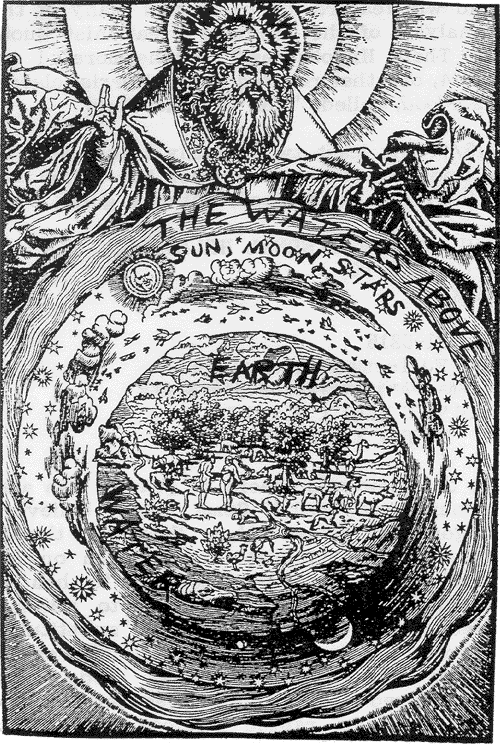
All one has to do to see the error of being Christian is look at this illustration from Martin Luther's Bible:

http://www.talkorigins.org/faqs/ce/2/fig1-large.gif

Regardless of what a sweet man named Jesus had to say as he gathered ancient Jewish people on hillsides around today's Israel, an organized church grew out of his teachings and those of Paul who rejected Jesus when he was alive.This church wed itself to Roman emperors eventually and became the establishment of Western Europe for centuries, even after it divided between Roman Catholic and protestant.
The world view of this Christian church and hence Christianity in general was that there is a god in whose image humans exist, never mind which humans, and that the universe is an Earth-centered work of art god has produced, wheeling about like so many spinning tops all interconnected and following precise mathematical laws. Everything Christianity insisted for centuries to be certain truth, all the perfect spheres within spheres, is now universally rejected.

All that is left to defend Christianity at all is the part of it that is humanistic. Love thy neighbor as thyself. OK. That is ethical. Kant had an Ethics that goes way beyond that maxim. So let's praise the love Christianity claims to have, despite the Crusades and countless other religious wars and the centuries of persecution and burning people at the stake for lack of orthodoxy, and let's move on.

As we toss out the absurdity of most of the worldview of Christianity, we must also throw out the mindless taboos and forbidden fruit that have gone with it since before Augustine. As the Earth revolves around the Sun, so does human existence revolve around sex and bodily pleasure. There is a twisted inversion of natural desire in the sacraments of Christianity. Rather than loving the body, we eat the dead flesh of god. We drink his blood weekly, if not daily. We do that so he will forgive our sins of the flesh. How absurd is that?
If we want communal sacraments, we ought to have a weekly orgy with people whose company we really enjoy. Let us share love and intimacy with people with whom we would like to have genuine communication, rather than practicing some mumbo-jumbo with an invisible, vengeful, jealous, spiteful demon god.


Jack

Tuesday, January 11, 2011

Hiatus

Looking over this blog, I see that I have written nothing here in a month. There are several reasons. The election over, I don't want to continue to dwell on political arguments. With the holidays came brief trips to Dillard and visits from others. We had the perfect white Christmas at the Dillard House with excellent food and half a foot of snow. A fireplace and our suite kept us warm. 

There are plenty of photos:


With January came Starr's three day visit and a New Year's Eve party at Maggie and Joce's home. It was all low key and pleasant. More good food. All through the holidays there was a sense of something I read somewhere that the end of the holidays would bring reality. Alfred Corn, I think it was, who posted some such on his FB page. Starr would get her divorce with all the difficulty that might bring. And Darryl would hear that there is no more work for him now that the editor on maternity leave has decided to return. Hard reality to face as 2011 gets into gear.

The snowstorm and the ice of the past three days have been good for reflection and stepping out of routine. I still don't know what lies ahead for us exactly, but as I read Patti Smith's evoking of her hardship with Mapplethorpe, their days at the Chelsea Hotel, and how their love and creativity blossomed despite poverty and his dying, I think that my life has gotten too soft, too bourgeois, too stalled. And so I repeat my mantra, Get out of Atlanta soon. Finish the novel-- it doesn't matter if it's any good or not-- just finish it. Write poetry. Change my life before I'm too old to change it. 

So the hiatus for this blog may continue yet awhile as I work on the novel. That, for now, is where my heart is--

http://savannahflashback.blogspot.com/

Jack

Tuesday, December 14, 2010

Ageless Socialism

The 'Filibernie' - Sen. Sanders' 8.5 hour argument against Obama/GOP Tax Deal


When I think of the 69- year-old Senator Bernie Sanders standing and explaining  the flaws in the current deal between Obama and the Republicans to extend tax cuts for all and extend unemployment payments for workers, I am awed by the dedication and purpose of this great statesman. As I try to decide which film to see tonight, as I enjoy my three weeks of vacation from teaching, as I write my self-indulgent blog, and ponder the meaning of life for a queer man in his sixties, Bernie Sanders offers up a burning, shining example of what a meaningful life an aging man can have. Of course, the good Senator comes from a state where people are, for the most part, educated and aware of the benefits of democratic socialism, a state that knows the dangers of unfettered capitalism. A simple drive across this green, lovely, rolling state reveals the enlightened refusal to let business run rampant with billboards and ugly factories. 


File:Vermont fall foliage hogback mountain.JPG
 Vermont in Autumn, from Wikipedia


Saturday, December 11, 2010

Solstice Approaches

http://upload.wikimedia.org/wikipedia/commons/0/0a/Santaandgoat.gif


From:
"Winter Solstice"
Wikipedia


Another winter solstice arrives in ten days, this time with a total lunar eclipse. Outside, beyond the screen porch, the skeletons of oaks reach up to a sky pale as death. It is impossible not to think of mortality on such a day, especially after suffering more stomach cramps and flu for two days. After my Wednesday visit to Dr. Malamis, and after receiving  a flu shot, strange it was to go from health to illness in less than 24 hours. Was it because of the shot, or eating a full meal at the Colonnade, big salad, fried chicken and limas? Or is there something else amiss, going back to my Thanksgiving illness?
It is noon, Darryl is still asleep upstairs, and I have watched a Swedish film about the troubled life a a woman photographer from World War 1 through the Twenties. Art arises out of  hard life experiences. No doubt, as I look around rooms of art, the huge Connatser in front of me that hung on my mother's wall for decades, two people conversing in a cubist world of turbulence. The Picasso lithograph of two figures confronting one another with masks. The Huichol jaguar with a peyote button on its forehead. Even the sculpted Buddha protected by a cobra. Art penetrates into the heart of life.
What better time to make merry, to decorate evergreen trees, to drink eggnog, and believe in sweet baby gods. The moon will turn blood red this Solstice as the dark winter caresses the Northern Hemisphere. Thus goes the cycle of death and rebirth. The New Year follows with dancing and champagne.


Sunday, December 05, 2010

Boardwalk Empire

Season 1 Finale was tonight; but there is more to come. A great look at the start of the Roaring 20s and the crime wave that began there and became a tsunami all the way to Chicago. Here's the Daily Beast's lovely review:


HBO’s Atlantic City gangster drama ends its first season tonight—Allen Barra argues that its excellence is unrivaled in TV history, and has only seldom been achieved in film.

In the first episode of Boardwalk Empire, directed by Martin Scorsese, Atlantic City political boss “Nucky” Thompson, played by Steve Buscemi, pensively gazes into a fortuneteller’s parlor. A short time later, we see the reverse shot—Nucky staring through the door’s oval window as seen from the inside. The shot replicates the double burn insert popular in newspapers in the 1910s and 1920s where a photo of a famous person was set in a smaller frame against a larger background–you’ll remember the technique from the front page of a newspaper in Citizen Kane featuring pictures of Kane and his mistress and their “love nest.”

It’s an arcane reference but a key one. Boardwalk Empire, which closes out its first season this Sunday at 9 p.m., has gone for the top rung in terms of authenticity and much more often than not reaches it. Nothing quite like this HBO series has ever been produced on television, and only seldom in the movies. A comparison to The Godfather and The Godfather, Part II wouldn’t be misleading. Boardwalk Empire is about the children and grandchildren of mostly Irish, Italian, and Jewish immigrants and how they came together to create organized crime as a springboard to becoming what one of the mob’s giants, Meyer Lansky, once called “real Americans.” For total evocation of period and mood—not merely the automobiles and fashions, but the sepia-toned lighting of the interiors, the ornate furnishings, and especially the music (Eddie Cantor, Bessie Smith, Caruso)—the series has no rival in television history. Atlantic City (actually Greenpoint, Brooklyn, across the East River from Manhattan) looks like a beautiful place for organized crime to be born. A crew of more than 300 constructed a 290-foot long boardwalk and, using an estimated 140 tons of steel, created hotels (including the legendary Ritz, the real Nucky’s favorite), shops, taffy parlors and photography studios at a cost in excess of $5 million. (The first episode alone cost nearly $18 million.)
It’s the closest thing television has given us to actually stepping back into another time period. The product of a collaboration between Terence Winter, a key Sopranos writer, and Scorsese, Boardwalk Empire has been slow to ingratiate itself with some viewers because it takes its own sweet time developing the characters and story line, and also because the tone from episode to episode–and thus the overall arc–has sometimes been uneven. This was probably inevitable, since Episodes 2-12 are the work of four other directors: Tim Van Patten, Jeremy Podeswa, Alan Taylor, and Allen Coulter, all veterans of the some of the best recent series on television—The Sopranos, Deadwood, The Pacific, and Mad Men. But this is a minor complaint about a show whose pleasures are so rich and varied–and when was the last time such adjectives could be used to describe a show about gangsters?
Some critics have complained that Boardwalk Empire is too much based on fact, while other say it is too much based on fiction. In the New York Times, for instance, Alessandra Stanley wrote that because “the series is based on a history book, Nelson Johnson’s Boardwalk Empire” the show’s writers “lack the confidence to improvise.” If Stanley had read Johnson’s “history book,” she would have found that it is mostly a social account of Atlantic City from its inception as a blue-collar vacation spot in the late nineteenth century to the coming of Donald Trump. In fact, much of the background for the show’s real life characters are taken from such storied texts about the early mob as The Last Testament of Lucky Luciano by Martin Gosh and Richard Hammer, Hank Messick’s Lansky, and recent books such as David Pietrusza’s superb biography of the early financier of organized crime, Rothstein.
Even many of the fictional characters are composites of real people. Criticism that much of the characters’ interior lives are invented is irrelevant; no one was there with a tape recorder when Rothstein, Lansky, Lucky Luciano, Al Capone, and other luminaries met in Atlantic City in 1920 to create America’s shadow corporations.
Article - Barra Boardwalk Empire Abbot Genser / HBO
Why Atlantic City and not New York or Chicago? As Nelson Johnson writes, “When it came to illegal booze, there was probably no place in the country as wide open as Nucky’s town. It was almost as if word of the Volstead Act never reached Atlantic City.” Surrounded by water, pine forests, and swamp and accessed only a few roads easily monitored by a corrupt police department, Atlantic City was a natural magnet for crime in the Prohibition era. And, of course, there was the lure of the Atlantic Ocean. As Burt Lancaster’s graying smalltime hood says in Louis Malle’s Atlantic City, “The Atlantic Ocean was really something back then.”
Each episode becomes an exercise in how far each character is willing to go before crossing a line that can’t be crossed back.
During Prohibition, Nucky Johnson, the real person on whom Buscemi’s character is based, was, according to the Johnson book, “both a power broker in the Republican Party and a force in organized crime, he rubbed elbows with presidents and Mafia thugs. But to Atlantic City’s residents, Nucky was hardly a thug. He was their hero, epitomizing the qualities that made his town successful.” If Arnold Rothstein was the grandfather of organized crime, Nucky was its midwife. Buscemi, a great character actor, would seem hardly to be anyone’s idea to hold a series like Boardwalk Empire together, but he has grown into the part over the course of the season, shedding apprehensions and inhibitions.
Early in the series, his protégée, Jimmy Darmody, a World War I vet turned killer played by a beautifully menacing Michael Pitt, tells him, “You can’t keep being half a gangster, Nucky." It’s a delusion shared by the show’s major characters. Michael Stuhlberg’s Arnold Rothstein wants to see himself as a good Jew who dabbles in gambling as a sideline and loans money to hoods as a business enterprise. Vincent Piazza’s Lucky Luciano would go on to become the most important mobster of all, but at the start of the series he is still conning himself into believing that running errands for Rothstein is the path to becoming a gentleman.
• Kara Cutruzzula: ‘Boardwalk Empire’ and TV’s Biggest DrunksIf some of the characters didn’t seem fully formed at the outset, it’s for good reason—they are gangsters in progress, creating the people who would serve as archetypes in hundreds of books, TV shows, and movies, particularly Stephen Graham’s Al Capone, who morphs from a jovial, sadistic playground bully into a full-fledged psychopath in front of our eyes. Each episode becomes an exercise in how far each character is willing to go before crossing a line that can’t be crossed back. (Graham’s Capone crosses his line about midway through the first episode.)
The great news for those who have become hooked on the show is that it has already been renewed for Season 2. It’s going to be a delicious few months anticipating the characters reaching their full splendor at the height of the Jazz Age when everyone as they become whole gangsters.

 http://www.thedailybeast.com/blogs-and-stories/2010-12-04/boardwalk-empires-season-finale/
Monday, November 29, 2010

Savannah Revisited


You are invited to view Jak & Dar's photo album: Savannah Thanksgiving 10
Savannah Thanksgiving 10
Nov 23, 2010
by Jak & Dar
Savannah T'giving
Message from Jak & Dar:
a few of the pics from Savannah

Friday, November 26, 2010

Pilgrims in Savannah

As James Land Jones said, my visits to Savannah are like a Fellini film. 
From the drive down the Thanksgiving trip was everything from upheaval to settling down in old Savannah Victorian camp charm.
Dinner at Ben Head's was delicious. My  Dad, who seldom eats much,  enjoyed a large helping of Molasses pork loin and sweet potatoes. Kathy talked of Michner's Texas, Darryl of Menchen, John of his daughter Maggie, Ben of the history of the Davenport House, and all of us , except silent, contented Dad, of the Catholic Church and Oscar Wilde, Kathy quoting, "Marriage is the triumph of habit over hate."

We  settled  into the Bed and Breakfast Inn and were upgraded to the Jasper House. Dar, John, Lee and Steve Killian,  Joe Mydell and John's friend Connie gathered one afternoon. Ben, Dad and Kathy joined the above for a Saturday get together in the double parlor.  Here is a glimpse of our house.


Sgt. Jasper House

Our most ornate, spacious, and discerning of accommodations. 

It is a three floor row house next to the inn.

 The oversized parlor and dining room of the Jasper House will sweep you back to a bygone time, with turn of the century furnishings, artwork, and decor. The remodeled gourmet kitchen will make you feel pampered. Upstairs are 4 bedrooms and 2 baths. Two bedrooms contain a single queen bed each, and two bedrooms contain two twin beds each. Each room is decorated with a unique style, and the Jasper House can accommodate up to 8 adults. The Jasper House is sold nightly as a choice room with inn amenities or for a weekly vacation rental rate without inn amenities.


 2nd floor bedroom with two twin-sized beds


 Dining room  Parlor and sitting area


Monday, November 22, 2010

Thanksgiving


Tennessee in Autumn
photo by Darryl


As we embark upon Thanksgiving week, there is much that I am thankful for. Today is my brother's 58th birthday and I am glad we shall spend the rest of the week together. I am thankful for Darryl's going with me to Savannah and for his new job editing that allows him to go virtually anywhere there is internet access. I am thankful for my good friend Joseph Mydell's visit this past week and the week ahead, for our renewed times together, and for his wonderful success as an award winning actor.

The week ahead offers more contact with our world of friends, with Lee and Steve Killian from North Carolina. Ben Head will host John, Dad, Kathy, Darryl and me for Thanksgiving dinner. And Darryl and I will have the spacious  Live Oak Suite at the Bed and Breakfast Inn to enjoy. It is a golden autumn here in Atlanta today, yellow leaves against the gray sky. Several warm days lie ahead here and in Savannah. So, it is a good time to reflect upon blessings: health, friendship, the opportunity to visit Savannah, Asheville, and Chattanooga where Starr is thankfully becoming Tays once more.

Always in my mind, these holidays, is the Epicurean Garden, where gather our kindred spirits. May it ever become more manifest in our lives.


Jack

Saturday, November 06, 2010

Good Bye Boneheads


Shooing the Blue Dogs and other mad dogs.


One more thought about the election of 2010. The win of the Republicans took place mostly in the suburbs that swung from Republican to Democrat in 2006 in disgust over Bush. Tuesday's election's big losers were mostly the so called blue dog Democrats who made everything progressives and Obama did difficult. They often shared with Republicans the ties to corporations and special interests. So I would say one major message from the election is a rejection of tepid, milquetoast caving to the hard nosed positions of Republicans. Commentators have laughed at the absurdity of thinking that independents voted Republican because Democrats were not far Left enough. That may seem like a paradox, but the fact is, the youth vote and the minority vote were seriously lacking in this election and it was their high percentages that swept Obama and Democrats to historic power in 2008. Note too that in many state-wide races the Democratic strongholds held, keeping the West Coast progressive-- in California, Oregon,  Washington and even Nevada-- as well as in New York, Connecticut, Maryland, and other Eastern bastions of Liberalism.

In my view, the way to energize those millions of progressive, young, minority voters  is to be tough, to fight for progressive reform with  more fervor than ever. You cannot compromise with evil- so said Rush Limbaugh in the most damning irony of the campaign. So, let's get on with our quest for equality in this country, with the freedom we can believe in: freedom to marry for all, freedom to serve in the armed forces, if we so choose, freedom to earn a good wage when we work, freedom to have health care when we are ill, freedom from pollution and corruption, freedom for the entire planet to be healthy, clean,  and peaceful. Finally, we should stand for the freedom of as many people as possible to find happiness-- the cornerstone of John Locke's and Thomas Jefferson's philosophy.

{ Read:  Life Liberty and the pursuit of Happiness (click)}

Jack
11/6/10

Wednesday, November 03, 2010

Blue

Blue


Portland Cityscape, Portland Rose Garden, Mt. Hood

Is there a lesson to learn from the swing of the House of Reps from Democratic to Republican last night? Did Obama fail to "connect" to the voters? Did the Tea Party Patriots sway the voters with good, sound anti-government argument? Had Pelosi and the Dems just been too socialist and ambitious?

Of course not. For one thing, there is no tea party. It doesn't exist. There are only corporation financed capitalists who know how to get the voters stirred up over meaningless terms like socialism and big government. There are so many ignorant, uninformed, easily misled, dare I say, stupid people in the "greatest nation on Earth," that candidates who have no interest in helping the middle class, much less the poor, the old, the sick, or the needy of the country, can win political contests on appearance and advertisement alone. Our Supreme Court has made it easier than ever for corporations, including those in other countries, to finance our elections, presenting false and manipulative ads more sophisticated than any on "Madmen."

Fortunately, the statewide electorates managed to keep the Democrats in power in the Senate. There will be no outrageous, right-wing bills from Congress that Obama must veto. But there is likely to be virtually no cooperation either. The House may even go so far as to "investigate" the Obama administration with impeachment on their minds.

Which brings me back to last night's lesson: Democracy does not work. It is not the best form of government. Besides, what we have is not democracy at all, but oligarchy, with millionaire candidates, and billion dollar campaigns.  Even with that setup, where voters choose which oligarchs to elect, an uninformed electorate repeatedly vote for the person least likely to support their interests, or worse, to work for private interests that bring them harm. Given that the sort of Republic for which Plato advocated is virtually impossible, and that malevolent dictatorship may be inevitable, I fall back and urge myself and friends to the fragrance of the Garden of Epicurus- a nice garden without debris blowers and with a fine variety of blooms. Today,  I can't help recalling the splendid rose garden in Portland, Oregon, and the uplifting view of snow covered Mount Hood.

Jack
11/3/10

http://upload.wikimedia.org/wikipedia/en/4/43/InternationalRoseTestGarden.png


Friday, October 29, 2010

The Tea Party Patriots (Election Approaches)


llustration:


Today's Tea Baggers worship the balls of the Koch Brothers. (click). The baggers  are  political finger puppets--  mean, cold, selfish, gun carrying fools of Rupert Murdoch, the Corporate CEOs who pay little or no taxes, the oil industry, and the mad hatters like G. Beck, Palin and other screaming loons who support reactionary 18th C. libertarianism. They would allow unlimited corruption, pollution, and abuse by an elite oligarchy that includes the Bushies and the Cheneys, Clarence Thomas and wife, Karl Rove, and the Republican fat cats who hate the poor, the middle class, and anyone not a member of their quail hunting, fast shooting club. How anyone who is not an indifferent, mindless multi-millionaire, living in a fantasy world where there is no global warming, where no one dies in wars, where gays are locked away, where Christmas is always white, could vote libertarian or Republican, when there is such suffering in the country and the world, is beyond me. Greed and ignorance to the point of self-mutilation are the order of the day.


Is there no way to lick the tea baggers? If only the Democrats had some balls...


Jack


Tuesday, October 19, 2010

Oligarchy

Mr. Reich echoes what we've been saying for some time: our nation has become an oligarchy (Plutocracy)


http://readersupportednews.org/opinion2/279-82/3651-the-perfect-storm

Robert Reich begins: "It's a perfect storm. And I'm not talking about the impending dangers facing Democrats. I'm talking about the dangers facing our democracy."
Portrait, Robert Reich, 08/16/09. (photo: Perian Flaherty)

The Perfect Storm

Robert Reich, Robert Reich's Blog
18 October 10

t's a perfect storm. And I'm not talking about the impending dangers facing Democrats. I'm talking about the dangers facing our democracy.
First, income in America is now more concentrated in fewer hands than it's been in 80 years. Almost a quarter of total income generated in the United States is going to the top 1 percent of Americans.
The top one-tenth of one percent of Americans now earn as much as the bottom 120 million of us.
Who are these people? With the exception of a few entrepreneurs like Bill Gates, they're top executives of big corporations and Wall Street, hedge-fund managers, and private equity managers. They include the Koch brothers, whose wealth increased by billions last year, and who are now funding tea party candidates across the nation.
Which gets us to the second part of the perfect storm. A relatively few Americans are buying our democracy as never before. And they're doing it completely in secret.
Hundreds of millions of dollars are pouring into advertisements for and against candidates - without a trace of where the dollars are coming from. They're laundered through a handful of groups. Fred Maleck, whom you may remember as deputy director of Richard Nixon's notorious Committee to Reelect the President (dubbed Creep in the Watergate scandal), is running one of them. Republican operative Karl Rove runs another. The U.S. Chamber of Commerce, a third.
The Supreme Court's Citizens United vs. the Federal Election Commission made it possible. The Federal Election Commission says only 32 percent of groups paying for election ads are disclosing the names of their donors. By comparison, in the 2006 midterm, 97 percent disclosed; in 2008, almost half disclosed.
We're back to the late 19th century when the lackeys of robber barons literally deposited sacks of cash on the desks of friendly legislators. The public never knew who was bribing whom.
Just before it recessed the House passed a bill that would require that the names of all such donors be publicly disclosed. But it couldn't get through the Senate. Every Republican voted against it. (To see how far the GOP has come, nearly ten years ago campaign disclosure was supported by 48 of 54 Republican senators.)
Here's the third part of the perfect storm. Most Americans are in trouble. Their jobs, incomes, savings, and even homes are on the line. They need a government that's working for them, not for the privileged and the powerful.
Yet their state and local taxes are rising. And their services are being cut. Teachers and firefighters are being laid off. The roads and bridges they count on are crumbling, pipelines are leaking, schools are dilapidated, and public libraries are being shut.
There's no jobs bill to speak of. No WPA to hire those who can't find jobs in the private sector. Unemployment insurance doesn't reach half of the unemployed.
Washington says nothing can be done. There's no money left.
No money? The marginal income tax rate on the very rich is the lowest it's been in more than 80 years. Under President Dwight Eisenhower (who no one would have accused of being a radical) it was 91 percent. Now it's 36 percent. Congress is even fighting over whether to end the temporary Bush tax cut for the rich and return them to the Clinton top tax of 39 percent.
Much of the income of the highest earners is treated as capital gains, anyway - subject to a 15 percent tax. The typical hedge-fund and private-equity manager paid only 17 percent last year. Their earnings were not exactly modest. The top 15 hedge-fund managers earned an average of $1 billion.
Congress won't even return to the estate tax in place during the Clinton administration – which applied only to those in the top 2 percent of incomes.
It won't limit the tax deductions of the very rich, which include interest payments on multi-million dollar mortgages. (Yet Wall Street refuses to allow homeowners who can't meet mortgage payments to include their primary residence in personal bankruptcy.)
There's plenty of money to help stranded Americans, just not the political will to raise it. And at the rate secret money is flooding our political system, even less political will in the future.
The perfect storm: An unprecedented concentration of income and wealth at the top; a record amount of secret money flooding our democracy; and a public becoming increasingly angry and cynical about a government that's raising its taxes, reducing its services, and unable to get it back to work.
We're losing our democracy to a different system. It's called plutocracy.

Robert Reich is Professor of Public Policy at the University of California at Berkeley. He has served in three national administrations, most recently as secretary of labor under President Bill Clinton. He has written twelve books, including "The Work of Nations," "Locked in the Cabinet," "Supercapitalism" and his latest book, "AFTERSHOCK: The Next Economy and America's Future." His 'Marketplace' commentaries can be found on publicradio.com 


Tuesday, October 12, 2010

Tea Bag v. Nickel Bag


Allen Ginsberg on Bourbon Street
photo copyright
Jack Miller


Sunday's New York Times Book Review ended with an absurd comparison of today's Tea Bag movement with that of the Beats. You can read it at:

http://www.nytimes.com/2010/10/10/books/review/Siegel-t.html?ref=books

 Besides claiming they both wanted individual freedom and opposed big government, the article just rambled on about the dissimilar, discordant traits of each.

Even to mention TV clown Glenn Beck in the same breath as Allen Ginsberg is to conjure up, as one of my friends put it,
Vomit.

How are they unalike? Let me count the ways:

Beats vs. Baggers


The Beats were a group of writers and artists who loved and explored alternate religions to Christianity. They pursued Buddhism and Zen.
Baggers are not writers, but the haters of books and intellectuals who mostly believe in a literal reading of the Bible.

The Beats explored and practiced expanded consciousness, including sexual experimentation with homosexuality, bisexuality, and group sex.
Baggers demonstrate reduced consciousness, conformity, and the denial of sexuality for anything but procreation. They condemn gays, want to outlaw the woman's choice of whether to have a baby, and even want to stop masturbation.  They have suggested that single, sexually active women should not be allowed to teach.

Beats reject materialism and brainwashing.
Baggers are funded by right wing billionaires who favor less taxes for the very rich. 

Beats are pro-ecology and love nature and the environment.
Baggers oppose any regulation of corporations, industry, or big oil. The environment is to be used up and wildlife is for the sport of hunters.

The Beats enjoyed being high on marijuana, for the most part.
Baggers don't even like tea and have no idea what the Boston Tea Party was about.


The Beats opposed war and the policies of Dick Nixon. They were diverse and fought for the rights of minorities.
The Baggers are mostly angry  white men and women who support spending more for the military , resent other ethnic groups, despise diversity, and are often bigots against blacks, gays, and women. Even the women in the movement oppose women's rights. 

The Beats were individuals, not a movement or party at all. The Hippie movement derived from the Beats, but was not a political movement either.
The Baggers are a political movement funded by the rich to help restore power to Republican corporate puppets.


The list of differences goes on...and on...


Jack

("I knew Allen Ginsberg. Allen Ginsberg was a friend of mine. Glenn Beck, you are no Allen Ginsberg." {Jack throws up} )


Peace.


Sunday, October 03, 2010

Irony and Facebook

File:Marcel Duchamp Mona Lisa LHOOQ.jpg

L.H.O.O.Q

This past week poet Alfred Corn asked the question on his Facebook page, "Irony--can it be defined in non-ironic fashion?"  Today, I saw the film Social Network and the ironies in the film spurred even more thought on the subject.

To begin, I'd have to answer Alfred's question by saying no. As soon as I even try to define irony, irony influences my thoughts, making me want to be ironic in my response. That is not to say we cannot talk about irony in a straight-forward manner, but that even when we do, there is an inclination to add a touch of irony. Irony is needed to explain irony.

Irony has unquestionably played a key role in my life. Accepting the label of gay in my 20s was blatantly ironic, I thought. Gay. The least gay thing about me was that I was gay. The very term is fraught with irony, going back to Oscar Wilde, no doubt one of the models used in creating the term for homosexuality. Yes, Wilde was gay, even in the horrors of his life in prison. What could be more linguistically ironic than the oxymoron, gay suicide, filling our newspapers today?

Irony is subtle; defining it ought to be not only difficult, but ongoing. Pin it down and it becomes sarcasm, cynicism, a joke, a witticism, a play on words, a pun, perhaps. Wikipedia breaks the term down into it's many exemplary uses, Socratic, tragic, literary, linguistic, artistic, and the like. Yet, those who use irony might well disagree on what is or isn't irony-- Duchamp's putting a mustache on Mona in L.H.O.O.Q., above, for instance.

The film, Social Network, presents us with a creator of Facebook, a network with half a billion friends, unable to be or keep a friend himself. Irony. And there are many other ironies in the film. If the story  has any truth to it, Facebook as it has evolved today is far more than the original idea as Mark Z. conceived it. If Facebook has become a substitute for making real friends, then that too is ironic. Yet, as I see it, Facebook has provided far more than a place to meet ones potential sex partners; it has become a place to communicate in a genuine way. What started out as a convenient way to stay in touch with friends and acquaintances has become a means of sharing ideas with those who share our interests, as well as a way to renew and maintain ties that we should not have lost. The implications for education using Facebook are just arising.

There is much more to both irony and to Facebook that I'd like to explore this gorgeous October day. But I have dinner plans, so those thoughts must wait.


BTW, there is a brilliant review of the film and its irony in the New Yorker:

Influencing People

David Fincher and “The Social Network.”

by David Denby

http://www.newyorker.com/arts/critics/atlarge/2010/10/04/101004crat_atlarge_denby?currentPage=all


Wednesday, September 22, 2010

The Ship of State

mike09222010


http://blogs.ajc.com/mike-luckovich/


 Our ship of state goes in circles. We are rounding the loop of 1980 when voters rejected the truth Jimmy Carter told us about conservation and using less oil. We are rounding the election of '94 when voters took out a contract on the Clintons for daring to promote health care for the poor and sick. By January, if all goes 'round as expected, Republicans will again shut down the government in order to guarantee the corporations unlimited power to do as they please. Why? The reason too repeats: misguided selfishness of the worst kind. It is not only that we will not recycle, not pay taxes to make the world a better place, it is that we want our phantom edge over the others, the immigrants, the blacks, the gays, the Muslims. We will not learn Spanish, damn it. Nor will our undereducated offspring.  Thank You Jesus (even if you really were for the poor and outcast, you Socialist). Vote Tea Bag.

Amen.