Monday, March 23, 2015

Letters from Iceland


Letters from Iceland
Darryl Gossett

Best read to the music of 
 Sigur Rós
who were performing Ágætis byrjun at the time Darryl heard them. 


Iceland, Oct. 18, 2000
Hi, there ...Eric, Jennifer, and I have found our way to the Top Cafe, an Internet coffee house in Reykjavik, and are taking this opportunity to send our greetings. The flight last night from Boston was tiresome but exciting at the same time. We arrived at 6 a.m. Iceland time -- about 2 a.m. Atlanta time! -- so we´ve been a bit disoriented all day as a result. It was a long but beautiful drive in from the airport... the sun rose as we arrived and illuminated the eerie-looking landscape. Our hotel is simple and clean ... quite wonderfully located, right in the middle of things and just a block or two from the harbor in one direction and from the famous ´lava´ church in the other direction. Today, we´re planning our adventures ... it looks likely that we will take the Golden Circle Tour of the waterfalls and ´geysirs´and we will definitely go to the Blue Lagoon spa and mineral baths on our way back to the airport. Surprisingly, the weather here has been spectacular... in the 40s, bright and sunny, clear clean air ... and we're surrounded by sweet-faced and sweet-tempered people. A ton of babies everywhere ... but all very quiet and well -behaved! The sun sets today at 6 30, so we will have plenty of sunlight. Well, Eric and Jen are sighing at my long-windedness,so I had better sign off. See you soon.
Love,
Darryl


Letter 2, Iceland, Oct 21, 2000



hi, again,
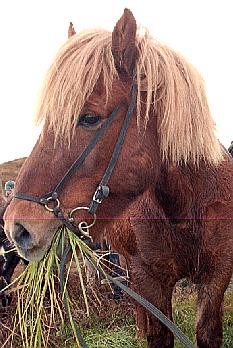
Yesterday was amazing. Another gorgeous day of around 50 degrees F. We left the hotel Skjalbreið at 9 30 am and by 10 the three of us were astride our trusty steeds ... the unique Icelandic horse, strong, short, sweet-tempered ... for a couple hours of riding around
the countryside. The group consisted of about 20 people maybe, and our guides led us through fields with clear views of the surrounding volcanoes and glaciers. We traveled at various speeds ... from a slow walk to a near gallop, bouncing up and down on the backs of out horses ... mine was named "Stone," or whatever the Icelandic word for that is.  


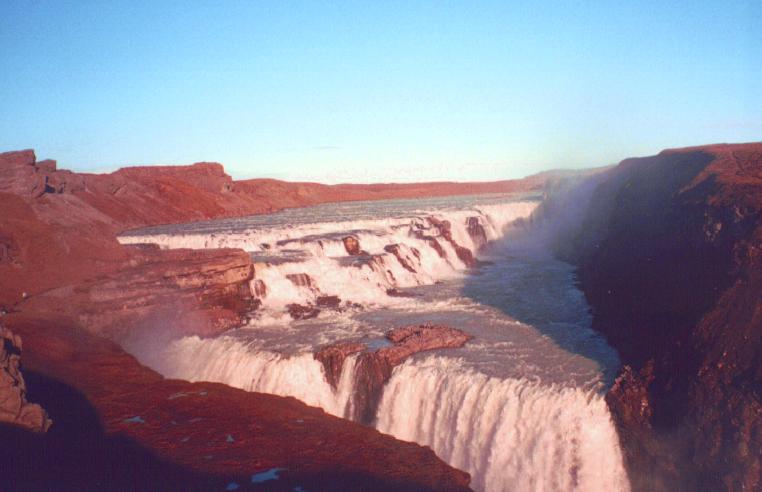
Then we had lunch ... a buffet of lamb chops and vegetables, soup, bread, and cold beer. Then we were off to spend a half hour exploring Gulfloss, surely one of the most beautiful waterfalls in the world. We had amazing views and were able to get very close. I  hope my pictures turn out OK .. there was so much
spray from the falls that the lens protector was constantly having to be wiped dry. then we drove further to look at the famous Icelandic "geysirs" ... these are where our word geyser come
from, and the granddaddy of them all is properly named "Geysir" .. it hasn´t been active for many years, but following a series of earthquakes this past June .. measuring 6.6 on the Richter scale! ... it is now erupting again! Geysir is surrounded by other, smaller geysers that also steam, burble, and erupt on a regular and frequent  schedule. Oddly, the sulfuric, steamy geyser plains are encircled by glaciers. You´d think one of them would give, the ice or the boiling water churning right beneath the surface!
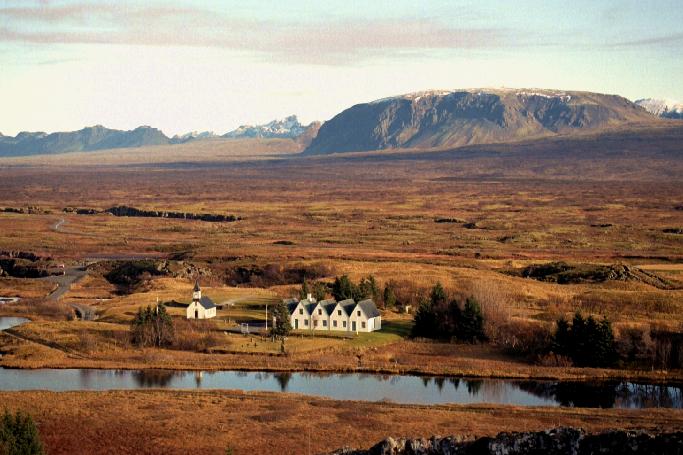
After a much-needed coffee break, it was off  to look at the very spot where North America and Europe are drifting apart! Yes, the place where the continents are divided, still moving at a rate of 2 cm a year, our guide said. One can still jump across the chasm, jumping from North America to Europe and back! ... and the mini canyon travels miles up into the hills until it disappears from sight. Some day, after many more years, the split will be complete and Iceland will be two separate islands.

Other highlights: beautiful lakes, a huge caldera formed by the explosion of  a volcano eons ago and now containing a "bottomless" lake in the center. Parents tell their children here, when they misbehave, that they will toss them into the lake and send them to Australia! A nice tour of the Icelandic greenhouses .. where the nation grows its vegetables and fruit and flowers. We saw banana trees, orchids, corn stalks, royal blue roses, etc.... a nice solution for a nation that can´t farm, but only has 270,000 people to feed. Eventually, tired, we made it back to the city ... 9 hours in all on the tour. After cleaning up and resting a bit, we were off to dinner at Rex, a stylish, ultra modern-looking bistro with burnished aluminum tables, chairs, napkin rings, etc., and multicolored glass embellishments. We opted for local foods ... Eric had salmon, Dar had tuna, and Jen had scrumptious local lamb. Dessert was chocolate sushi! The day was just getting started! Back to the hotel again, to change into our club wear, have some drinks in Jennifer´s room (where we shouldn't have turned on the TV!! ... the things they show on the TVs here would cause pandemonium in the States!) After much giggling and blushing, we were off to Spotlight, the city´s premiere disco, where several bands were playing ... Möa, XXX Rottweiller, Bellatrix (great, all-girl band), and the campy Paul Oskar, sort of an Icelandic Cliff Richard, if that makes any sense. Everyone is the place knew the words to every song of his (all in Icelandic, so we were clueless), and there was much merriment and dancing and laughing, everywhere. The Icelanders really know how to club.
Afterward, we turned down an invitation to go to some little town outside the city and watch a Mike Tyson boxing match (huh?) with these guys, and instead went to a late club ... Thomsen Klub ... and danced in their downstairs disco until 4.
OK, *then* the night was over. Luckily, we weren't more than a 5-10 minute walk from the hotel, so we stumbled happily back, complaining about how sore the horses made our butts, how tired we were, etc., and off to bed!

--dar 
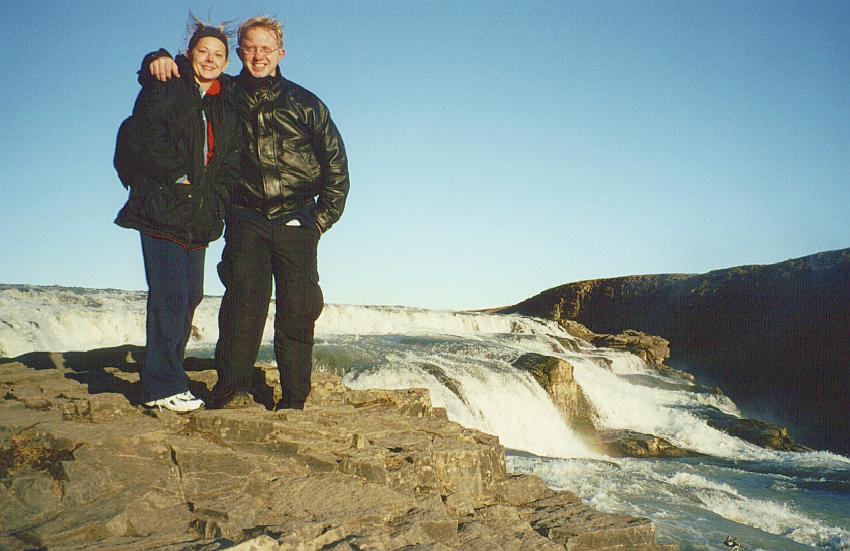

Darryl and Jennifer
(photo by Eric)


2000


the photo above (by Darryl) is of Guanajuato 

2000 began with a New Year's celebration at David and Birgit McQueen's party. A couple of weeks later, we flew to Boston. Then, after the winter ice storms, and after the WebMD-sponsored party and private performance at the Fox by Sir Elton John, we began a series of spring and early summer trips: San Diego, San Antonio, Kennebunkport, and Darryl to Chicago. We spent Memorial Day in Asheville with Bob and Pamela, Starr and Bruce. We even hiked through Craggy Gardens.The highlight of summer was --
Our Civil Union .

More Summer 2000

In November, we had a warm visit to San Miguel (we stayed at Casa Luna) and to Guanajuato (Casa de Espiritus Alegres).

the photo above (by Darryl) is of Guanajuato

click it for the Mexico page.

And don't miss Darryl's Icelandic adventure (read his letters from Iceland).

The Christmas holidays gave us a whole new set of adventures:

Photos of X-mas and New Years.

January 2001 on Miami Beach (NY Times article on South Beach):

We slept to the sound of the ocean waves beneath our open windows and dined on seafood at cafes in South Beach.

The blue water and sunny beach formed the perfect contrast to the wonderful, snowy New Year's celebration at Fall Creek Falls state park in Tennessee with Starr, Bruce, Pamela, Bob, and other friends. From walks through the wintry woods to the waterfall to poetry and fiction readings in our spacious lakeside cabin, it was a great way to end our vacation.

We also enjoyed theatre and art in New York . We appeared on the Letterman Show and saw such exciting Broadway plays as Cabaret and Copenhagen.

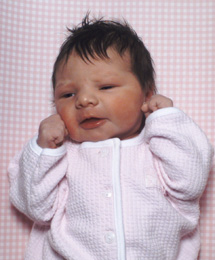
Our neice, Maggie Vivian Miller, daughter of John and Donna, entered the world on Dec. 11, 2000.


Recalling 1999


Dec. '98 - July 1999 
More photos from Greece 1999

Below: Arizona, New Orleans, and Greece 


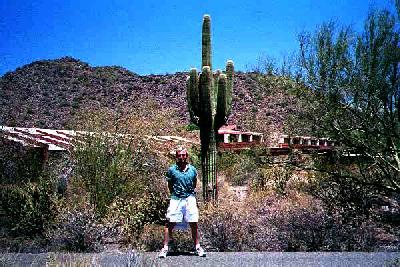
Darryl at Frank Lloyd Wright's Taliesin West.
Photo by Jack

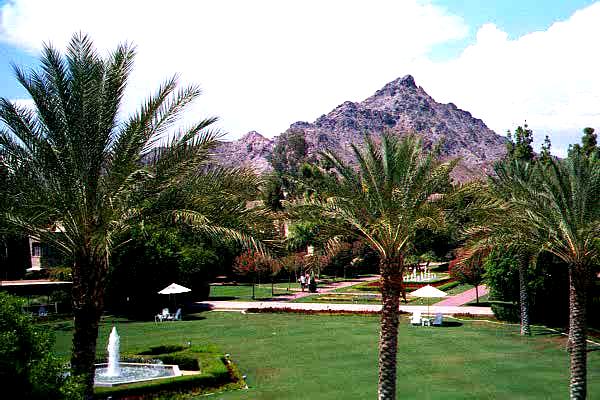
We spent the 4th of July in Arizona,
residing in a suite at the Arizona Biltmore and paying a visit to Taliesin West.

New Orleans and Greece: We spent Christmas '98 in New Orleans, went to Savannah after New Years, visited Paula and Joe in Baltimore in April, and spent two weeks in Greece in June '99. For the 4th of July we went to Arizona.
Mom takes the cake...at the Palace Cafe (photo by Justin)


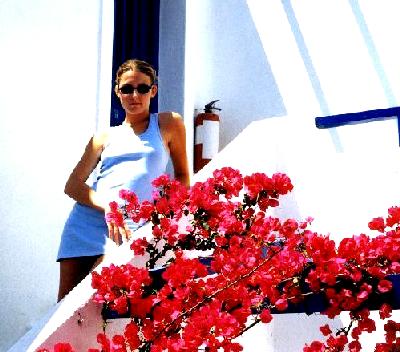
Starr's niece Natalie on Santorini, June '99
photo by Jack


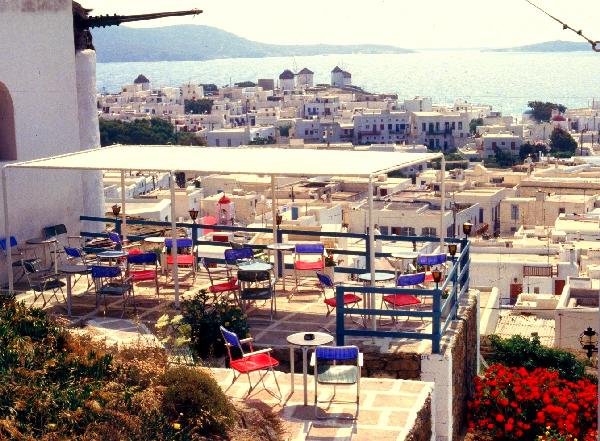
Mykonos: second visit, June 1999
Photo by Jack, 1985 Recently Scanned Photos

including Jack in New Mexico and both Paula and Jack
in Baltimore,


Recalling 1998


Summer 1998 
Jack and Darryl's Excellent European Adventure 

Canal view,

Amsterdam '98

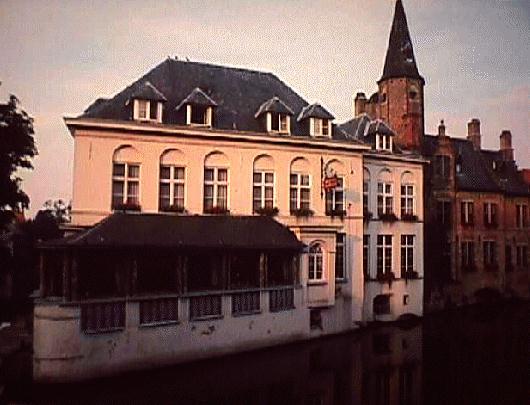
The Duke of Burgundy Hotel where we stayed in scenic Bruges, Belgium

(All photographs on this page by Jack)


Darryl as the demigod Pelops in the onstage performance of Cafe Ooh-La-La in Amsterdam
before a thousand fans. (from the video by Jack)


Darryl and Amy with baby carriage
Luxemburg Gardens, Paris '98


Amy, Lucie and Dar at the Creperie,
Blvd. Montparnasse

We had a truly exciting visit to the Netherlands, Belgium and France. Dar's participation in the Tennis matches on red clay courts, and in the Cultural events was great fun. We hope to add more photos soon of the Opening ceremonies of the Gay Games and performances in the central plaza of Amsterdam.


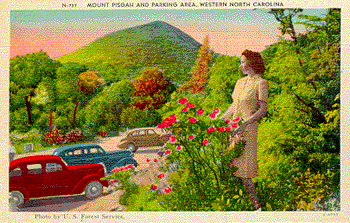
We also went to Mt. Pisgah and Asheville with the Killians and brother John just before our trip to Europe in August...

Article on Darryl's participation in the 1998 Games in Amsterdam:


All Aboard for Amsterdam!

Atlanta will be well-represented at the Gay Games in the Netherlands August 1-8

by DAVID GOLDMAN
The fifth Gay Games are still nine months away, but lots of Atlantans are already planning trips to Holland for the week-long August celebration.
More than 150 people have signed up so far with International Travel Center, according to Joop Petiet of the Marietta travel agency, which is making arrangements for the Atlanta Sports Association, a gay and lesbian sports alliance. Petiet, a Netherlands native who will accompany the group, said he has gotten "a very good response" from Georgia athletes and other community members as well as from people in Florida, Alabama and elsewhere.
"Pooling our resources to go over and represent Atlanta is very exciting," said Christopher Lee, a member of ASA and the Atlanta Rainbow Trout. "The idea of standing up on a block and swimming at the Gay Games gives me goosebumps. It's a total acceptance of who I am. I grew up swimming while I was still closeted. This brings the two parts of my life together," Lee said.
According to Lee, ASA has signed up approximately 18 swimmers, 20 tennis players, 18 soccer players, 12 runners, 30 volleyball players and 20 basketball players. As of the July 31 deadline, 6,587 athletes had pre-registered worldwide for the Games. Registration on an as-available basis will continue through April 30, 1998, according to the Games website.
One of those pre-registered is Darryl Gossett, a writer and editor with Emory University and a member of the Atlanta Team Tennis Association who recently played in the Peach International Tennis Championships here. Gossett is planning to make the trip with his partner, Jack Miller. "Any excuse to get back to Europe is good," said Gossett. Tennis matches at the Games will include players whose ability ranges from novice to professional, he said.
Like the Olympics, the Gay Games have a cultural component, and there, too, Atlanta will be well-represented. According to Nina Gooch of the Atlanta Freedom Marching Band, the 20 members scheduled to make the trip account for almost half of those from the United States now committed to perform with the Gay and Lesbian Bands of America. Gay bands from around the world will take part in the opening and closing ceremonies as well as other special events. Lavonne Casey of Rainbow Traveller said the package the agency has assembled for AFMB members is also available to individuals and other groups.
More than 2,200 vocalists from gay choirs are expected to attend the Games choir festival. David Puckett, managing artistic director of the Atlanta Gay Men's Chorus, predicted that his group will be one of the largest. Approximately 100 AGMC members will already be in Europe to perform in a special Paris concert with the French gay chorus Melo Men. "Hopefully, we'll have the same number in Amsterdam," Puckett said.
Marilou Mycko, publicity chairperson of the Atlanta Feminist Women's Chorus, said that while the chorus has no plans to go over as a group, individual members may participate.
Other cultural events will highlight the visual arts, theater, floral arrangement and other arts. Visitors can also help create and star in a lesbian and gay soap opera.

Gay Games details

All indications are that Amsterdam plans to roll out the red carpet for the fifth Gay Games. The official brochure opens with a welcoming letter from the city's mayor. The Games will be the largest international sports and cultural event ever held in the Netherlands, with 15,000 participants and 30,000 visitors expected to take part each day. On the Games' final day, more than 100 boats will cruise the city's most scenic canals in a spectacular boat parade.
Many events will take place in the Amsterdam ArenA. This futuristic facility, which opened last year, will hold 50,000 spectators during the opening and closing ceremonies and features a retractable roof for all-weather enjoyment.
Beyond Amsterdam, millions of people are expected to follow the Games via television, radio, print media and the Internet.
The 30 sports that make up the Games include some familiar from the Olympics -- track and field, swimming, softball and cycling -- as well as numerous interesting additions like bowling, contract bridge, chess, and dancing -- including wheelchair dancing.
The Games are open to all, according to official publications, "regardless of race, gender, physical ability or sexual preference." The Netherlands have no restrictions for visitors with HIV/AIDS.
The Gay Games governing body is the Federation of Gay Games. The Games were first held in San Francisco in 1982 and were the brainchild of gay American Olympian Tom Waddell, who died of AIDS in 1987. Held in New York in 1994 to coincide with the 25th anniversary of the Stonewall rebellion, the last Gay Games drew 12,000 participants from 40 nations.
Tickets for all events will go on sale Dec. 1. Order forms will become available from the Games website on Nov. 15. Visitors passes -- which include entrance to non-final events, public transportation and opening and closing ceremonies -- will also go on sale Dec. 1. The website includes information on ordering Friendship Magazine, the Games' official publication.

All about Amsterdam

Amsterdam's long history of social liberalism makes it especially suited to host the Gay Games. The Netherlands legalized homosexuality in the 1970s, and the age of consent is 16. Prostitution is legal in its famous Walletjes district, which tourist materials proudly promote alongside the city's canals and museums.
The Amsterdam Gay Tourist Map distributed by the Netherlands Board of Tourism includes notices for "jack-off" parties and an "S&M group for women," and ads for bath houses and teenage escorts sit side-by-side with ads for diamond dealers and travel agents. Marijuana and hashish enjoyed "condoned" status and are sold openly in some coffeeshops.
The Netherlands' 1814 constitution established a hereditary constitutional monarchy, which remains the nation's form of government. Holland's horrible occupation by Nazi Germany -- 1940 to 1945 -- is memorialized in the Verzetsmuseum (museum of Dutch resistance) -- and in the Anne Frank House, where the young diarist and her family hid for three years in a doomed attempt to avoid the death camps.
The Amsterdam region has been inhabited for more than 2,000 years. Because much of the Netherlands lies below sea level, its residents were building earthen dikes to hold back sea water as early as 1000 A.D. In the 13th century, the windmill was invented to pump excess water away from farmlands. Today more than 3,400 miles of canals crisscross Holland.
Fifty miles of canals fan out through Amsterdam, whose 70 islands are connected by 1,000 bridges. In the 17th century the city became one of the world's richest, an economic powerhouse of trade and banking. Wealthy merchants built grand homes along its canals and commissioned portraits by artists like the great Rembrandt. Hundreds of the master's works are on view in the Museum Het Rembrandthuis, his home and studio for 20 years.
Visitors to the Gay Games will be among the last to have the opportunity to tour the city's Van Gogh Museum prior to its closing for six months to undergo a $15.5 million renovation and expansion. Built in 1973, it attracts more than one million visitors annually.
Contemplating an adventure in Amsterdam? Here are some sources for more information.
Toll free: (888) GAY-GAMES
(888) GOHOLLAND
Websites: www.dds.nl/~gaygames
www.goholland.com
For a free CD-ROM: e-mail Go2Holland@aol.com

  
1998: A very good year.

Jack


1

Wednesday, February 18, 2015

Going North

Our Valentine's Stay 2015 at the Dillard House.

Bucolic Dillard Pasture


Welcomed by the horses.

Our stone Fireplace
View from our balcony


The snow and sleet begin


Room with a view-from our window and porch...


Dining at the Dillard House on a summer stay (photo by Wolfgang)
--Jack 

Thursday, January 08, 2015

Holidays in New Orleans and Savannah 2014-2015

New Orleans and Savannah

The road to the Gulf-- Starr's Prius


Joseph Mydell and Alfred Corn: Georgia Actor; Georgia Poet...


Eight days into January and I feel at last that we are home and the holidays complete. The drive to New Orleans, especially the 8 hour return in the rain, wore us out; but did not diminish the fullness of culinary excess we experienced at Galatoire's Restaurant - New Orleans, the Gumbo Shop, Tujague's Restaurant, and especially Susan Spicer's Mondo. The art we saw, beginning in Atlanta with the Cezanne and post-Impressionists show and the exquisite photographs of Gordon Parks at the High Museum of Art, Atlanta, continuing with the Basquiat show at the Ogden Museum, and art galleries, continued on to Savannah, with the innovative interpretation of Dante's Divine Comedy (click) by several African artists. In New Orleans, Joe purchased a painting at the Antieau Gallery (click). We also visited Longue Vue House and Gardens where we saw and purchased some of the gorgeous jewelry of Mario Villas (click).


If food and art were themes of the holidays, so too was camaraderie. Despite Darryl's ducking into and hibernating in our luxurious suite at the Place D'Armes, there was much walking the Quarter, hearing music, and good conversation among Joe, Starr, KT, and me. Starr, Joe, and I took the St. Charles Streetcar uptown for a look at Tulane, Audubon Park, and the grand houses from the Garden District to the Camellia Grill, where we stopped for a late lunch or a piece of Coconut Cream Pie.
 
Starr and Joe on the
St. Charles Streetcar

In Savannah, Alfred Corn joined Joe, Effie, Darryl and me for walks downtown, a sort of VIP visit to the Flannery O'Connor Childhood Home, provided by Jane Fishman, and a stroll on the wind-swept beach by Dar, Alfred, and me-- before joining John for the traditional fresh shrimp at CoCo's Sunset Grille. Conversation was always lively, whether over a game of Scrabble or sitting on the Jasper House balcony having breakfast. On our walks, I pointed out Savannah's key houses and gave a few stories of clandestine trysts therein. On our final evening in Savannah, John, Joe, and I attended the classical performance at the Unitarian church featuring Effie and others. We followed the music with our own reception; then dinner at Vic's on the River.
[  Unitarian Universalist Church of Savannah ]

The concert this past Sunday was glorious, featuring pianists Sanford Jones & Marvin Keenze, soprano Stacey Stephens, & violinist Effie Mydell. What a warm and welcoming crowd we had, too - even with a tornado warning outside!


Unitarian Universalist Church of Savannah


Dad and Dar can Dance


John and Dar also joined me for a riverside get-together with Dad, now a doting 93.

 Darryl accompanied me to a celebration of Albion's Voice, where I spoke along with Bill Strong and former Mayor and activist Otis Johnson.

Connect Savannah published an account of the reunion:  http://www.connectsavannah.com/savannah/shouts-from-the-underground/Content?oid=2517150

For New Year's Eve, John, Alfred, and I walked to the river where, just as we set foot on the plaza near the Waving Girl, the fireworks show burst into action. 2015 has arrived.

Enjoy our  Photographs of our Holidays (click):
https://picasaweb.google.com/106057231025325213398/Holidays20142015
Christmas Day: Jackson Square and St. Louis Basilica


Tuesday, January 06, 2015

Albion's Voice copy


Shouts from the underground 

A look back at the gleeful subversiveness of Albion's Voice

Will Strong (l.) and his Armstrong college buddy Otis Johnson reunited to celebrate Albion’s Voice, the underground newspaper Strong started in 1970.
IN A WAY, 1970 seems like a million years ago, ancient history, even:
Gas cost 36 cents a gallon, and a postage stamp was six cents. Richard Nixon hadn’t yet disgraced the presidency, and Neil Armstrong’s footprint on the moon was a brand-new marvel.
The country aggrandized its economic and industrial accomplishments, but it was also a year of outrage and sadness: Enmeshed in Vietnam, U.S. troops invaded Cambodia.
The National Guard shot and killed four student anti-war protestors at Kent State. Jimi Hendrix and Janis Joplin both O.D.’d.
By then Savannah had made it through the Civil Rights Movement with remarkable unity and minimal drama. But macro social and environmental shifts still eluded the city in 1970, as city leaders doggedly resisted school desegregation and begrudgingly built a sewage treatment plant only after repeated threats from the State Water Board.
“The ‘60s came to Savannah in the ‘70s,” drily notes lifelong activistTom Kohler, a student at Armstrong University—then Armstrong State College—that same year.
The fact that the counterculture made it to Savannah at all may well be attributed to a kid named Bill Strong, who had traveled to San Francisco and maybe inhaled at People’s Park in Berkeley and saw that America was on the brink of cultural and sociopolitical revolt.
The Southern son returned to Savannah a long-haired hippie freak, determined to get something happening here, though just what wasn’t exactly clear.
The doors of perception unfogged in 1970, when Strong got his hands on a $750 grant to start a literary publication at Armstrong. He and a handful of like-minded bohemian weirdos launched Albion’s Voice,an underground newspaper that attacked the scourges of racism, women’s inequality, environmental degradation, unchecked capitalism, gay bashing, police brutality and other topics that the self-proclaimed decent folk hoped to suppress and ignore.
With a handwritten aesthetic and scissor-cut graphics from William Blake’s The Marriage of Heaven and Hell, Albion’s Voice resembled a cross between an 18th-century political pamphlet and a Grateful Dead poster.
Unafraid to confront the status quo with gleeful sedition, its founders thumbed their noses at threats from the KKK and a city plot to plant drugs in their office.
They sold their papers illegally, declaring a Free Speech Zone at the corner of Victory and Bee Road (right across the street from the current Connect offices. Coincidence or conspiracy?)
“The potential for change was so great, and we reveled in being rebels,” recalled Strong—who grew up to become Will instead of Billy—at a packed Sentient Bean last Saturday during a reunion for Albion’s Voice contributors.
The revelry was short-lived, however: After Albion’s Voice published an article about Union Camp’s horrific polluting practices, the college’s administration kicked the paper off campus, forcing it to go truly underground—or rather, into the living room of English professor James Land Jones.
Strong and his crew of subversive rabblerousers managed to publish a few more issues, but it was hard to find sympathetic advertisers (shocker!) to pay for print costs.
The last edition—and its first annual Save the World issue—dropped the same year.
“Obviously, the time isn’t right for Savannah to have this kind of paper,” lamented Strong in his last editorial.
click to enlarge‘Information architect’ Brittany Curry chronicled the ‘zine’s history.
  • ‘Information architect’ Brittany Curry chronicled the ‘zine’s history.
Forty-five years later, in a strange turn that would’ve seemed inconceivable and probably a total sellout back then, all six issues of Albion’s Voice have now been archived at Armstrong’s Lane Library.
“As far as we know, this is the only complete set in existence,” said Special Collections librarian Caroline Hopkinson, who digitized the collection.
Hopkinson emphasizes that the pirate paper’s preservation was made possible by Armstrong history professor Mark Finlay, who rediscovered Albion’s Voice while researching environmental activism in Savannah. Dr. Finlay had pushed for its proper recognition for years before he died tragically in a car accident in 2013.
Faculty sympathizer Jones is gone, too—murdered in the late 80s—and his partner Jack Millerdonated the collection from his personal belongings. Also commemorated at the reunion wasAaron Buchsbaum, the beloved local civil rights attorney who passed away earlier this year and, according to Strong, spent much of 1970 bailing kids out of jail for selling Albion’s Voice on Savannah’s streets.
In the first week of 2015, more than 100 people paid homage to the little liberal rag that shook its fist at the Man: Student firebrand and immigration advocate Elly Marisol Estrada addressed the subjugation of women then and now, and Armstrong alum Mickey Youmans quoted an article about the industrial wasteland of the Savannah River that sounded like it could have been written last month. (Oh wait, it was.)
Jim Reed delivered a truly memorable reading on the perceived sexuality of black men, cheekily written by none other than the Rev. Leonard Small, another longtime apostle in the ranks of Savannah’s community activism. Information architect Brittany Curry chronicled the ‘zine’s history in a spray of colorful markings.
Big applause came when former mayor Otis Johnson, Armstrong’s first black student and an icon of Savannah’s Civil Rights movement, called for a rebirth of the movement that demanded social change through a vocal free press.
“I still believe in America’s unfulfilled promise of freedom, justice and equality for all,” he vowed.
I think most of us do. And since you’re reading this, you probably also dig the idea of a publication that questions mainstream authority and tries to present alternative viewpoints.
click to enlargecivil1-3.jpg
    Yet audacious editorials only go so far.
    “Underground newspapers can serve as a weathervane,” reminded Strong. “But they can’t create a revolution.”
    Dude, tell me about it. As someone who’s been shout-writing about injustice and ineptitude for 20 years at free newspapers, I have yet to instigate a single riot.
    We might think of 1970 as the olden days, but in 2015 we’re still writing about the same goddamn problems: Endless war. Police brutality. Protests in the streets. Racial and socioeconomic disparity.
    The Port of Savannah may have grown and the hotels on River Street gotten taller, but the future of the river and the schools and the job market look as bleak as they did when the Albion’s Voice kids wrapped the Confederate Memorial in Forsyth Park with protest signs (Savannah’s first yarnbomb?!)
    Yet somehow, this city has managed to support Connect for over 15 years, and though any alternative press must now compete with cat videos and listicles about celebrity boob jobs, the legacy of Albion’s Voice is the stubborn belief that the “potential for change” that bubbled up in the 1960s will one day be permanently activated.
    That, of course, will require action: A new project by Emergent Savannah is asking every one of us two questions over the next few weeks:
    What do you love about Savannah? What do you dream for Savannah?
    Post your answers at the Sentient Bean (that bastion of rebellion!) through January, after which they’ll be collated into a collective vision and a strategic plan for the city we want to create.
    We don’t need a weatherman to know which way the wind blows, friends—but we do need to get our heads out of the 1970s.
    And to fulfill the promise of liberty and justice for all, we have to show up for the revolution.
    cs
    Read all six issues of Albion's Voice at library.armstrong.edu/speccoll.html