Thursday, February 28, 2013

Intoxication


An excellent essay on the Humanist approach to alcohol, drugs, religion and sex.
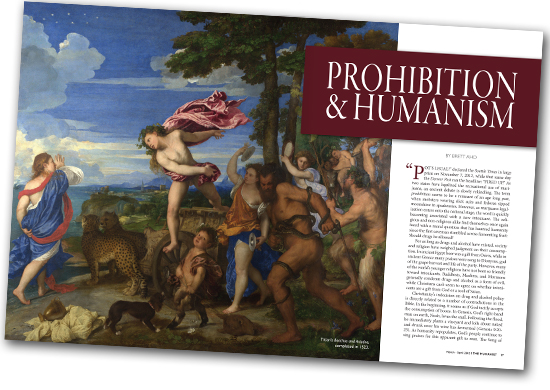

Prohibition & Humanism

“Pot’s Legal!” declared the Seattle Times in large print on November 7, 2012, while that same day the Denver Post ran the headline: “FIRED UP.” As two states have legalized the recreational use of marijuana, an ancient debate is slowly rekindling. The term prohibition seems to be a remnant of an age long past, when mobsters wearing slick suits and fedoras sipped moonshine in speakeasies. However, as marijuana legalization enters onto the national stage, the word is quickly becoming associated with a new intoxicant. The religious and non-religious alike find themselves once again faced with a moral question that has haunted humanity since the first caveman stumbled across fermenting fruit: Should drugs be allowed?
For as long as drugs and alcohol have existed, society and religion have weighed judgment on their consumption. In ancient Egypt beer was a gift from Osiris, while in ancient Greece many praises were sung to Dionysus, god of the grape harvest and life of the party. However, many of the world’s younger religions have not been so friendly toward intoxicants. Buddhists, Muslims, and Mormons generally condemn drugs and alcohol as a form of evil, while Christians can’t seem to agree on whether intoxicants are a gift from God or a tool of Satan.
Christianity’s indecision on drug and alcohol policy is directly related to a number of contradictions in the Bible. In the beginning, it seems as if God tacitly accepts the consumption of booze. In Genesis, God’s right-hand man on earth, Noah, loves the stuff. Following the flood, he immediately plants a vineyard and lolls about naked and drunk once his wine has fermented (Genesis 9:20-25). As humanity repopulates, God’s people continue to sing praises for this apparent gift to man. The Song of Solomon contains beautiful poetry comparing the joys of love to the intoxication of wine (Song of Solomon 1:2, 7:9). Later, when the wine runs out at a wedding, God’s own son goes on a celestial booze-run, reinvigorating the party (John 2:1-11). Given that precedent, one would think that Christians would host keggers every Sunday. However, as Alcoholics Anonymous will tell you, there are many other Bible verses that simultaneously condemn the consumption of intoxicating beverages.
To a nontheist, it seems rather silly to try and divine whether an all-powerful God smiles or frowns when you take a shot of tequila. However, in societies all around the world, religious lawmakers continue to ask that very same question, enacting strict prohibitionist measures as a result. As self-envisioned servants of God, they feel their duty is to bring divine law to his jurisdiction. With religion as their hammer and the law as their chisel, governments the world over actively persecute those nonbelievers who hold their own codes of morality when it comes to inebriating substances.
In the Islamic world, many drug and alcohol laws come straight out of the Koran, which teaches that khamer, or intoxicants, are instruments of Satan. In Saudi Arabia, getting caught with a beer comes with a punishment of forty lashes; a rather mild sentence when one considers that in much of Southeast Asia, drug possession often merits the death penalty. As the prophet Mohammed said, “Whosoever drinks wine, whip him. If he repeats it for the fourth time, kill him.”
The United States saw its fair share of religiously motivated moral legislation in the early twentieth century, when Evangelical Protestant churches and religious fundamentalists pushed for the prohibition of alcohol, intent on removing this “evil” from society. The Rev. Mark Matthews, a leading figure in the temperance movement, famously noted, “The saloon is the most fiendish, corrupt, hell-soaked institution that ever crawled out of the slime of the eternal pit. …It takes your sweet innocent daughter, robs her of her virtue, and transforms her into a brazen, wanton harlot. …It is the open sore of this land.” With the ensuing ratification of the Eighteenth Amendment in 1919, religious conservatives believed that God’s will had been done, and that the United States had succeeded in taking a bold step towards achieving heaven on earth.
However, to their dismay, after the law took effect in 1920 people kept on drinking, and the United States was soon facing a rampant problem with organized crime. The “noble experiment,” as it came to be known, ended in 1933 with the passing of the Twenty-first Amendment, and the power to regulate alcoholic beverages was passed back to the states. Today, many of these religiously fueled state laws remain unchanged in rural America. “Dry Counties” are a common occurrence in the South, and all across the United States unusually harsh punishments abound for underage drinking, public intoxication, and other nonviolent alcohol-related offenses.
There are those Americans who view the so-called “war on drugs” as Christianity’s most recent attempt to push moral prohibitionism on the masses. Sam Harris, author of The End of Faith, for example, calls it a “war on sin,” noting that the organizational factor behind current U.S. drug policy is to simply outlaw “anything which might radically eclipse prayer or procreative sexuality as a source of pleasure.” The bottom line, Harris argues, is that intoxicants are perceived by religion as a threat to individual faith.
This begs the question, does current drug policy truly serve the objective betterment of society, or has it been pointedly enacted by religious zealots attempting to push their interpretations of sacred text on the masses? A 2010 Pew Research Center poll found that while 64 percent of the religiously unaffiliated believed marijuana should be legalized, only 33 percent of Christians shared that view. Indeed, it is religious interest groups that have been the driving force behind anti-drug policies in the United States. The two largest Christian lobbying groups, the U.S. Conference of Catholic Bishops and the Family Research Council, are major funding sources for anti-legalization efforts. Just as the temperance and prohibition movements of the early twentieth century were largely fueled by religious fervor, it is reasonable to conclude that the modern war on drugs is in large part fueled by Christian moral interests.
The legislation of morality is widespread; from blasphemy to gay inequality to reproductive rights, religious majorities actively persecute those with differing values through the codification of morality. And while many of these marginalized groups have seen notable public support, the public is largely silent when it comes to the marginalization of those who choose to use drugs. Just as religion often labels those with alternative sexual preferences as morally corrupt or evil, so too does religion judge those who choose to use drugs and alcohol as morally inferior.
Part of the philosophy of humanism is to stand against outdated codes of morality that persecute and make life difficult for people. Just as LGBT issues are humanist issues, so too are drug and alcohol issues. When evaluating how society treats inebriants, science and reason should be the standards by which we create policy, not ancient religious texts. Most comparative policy studies agree that drug and alcohol abuse should be regarded as a public health issue, as opposed to a criminal justice issue, and that public funds are best spent on drug treatment and prevention rather than enforcement and incarceration.
Predominant theocratic norms have so influenced society that tacit acquiescence for religious prejudice has largely replaced critical analysis when it comes to social attitudes towards drug use. Indeed, there is little opposition, even among nontheists, to laws that persecute those who choose to use drugs. However, humanism and human decency afford that individuals with varying values and beliefs should be respected, not shunned.
One example of a largely unopposed, overly harsh drug law in the United States is the Higher Education Act’s Aid Elimination Penalty, which states that any individual with a misdemeanor drug offense is to be barred from receiving federal financial aid to attend college. Because of the provision, hundreds of thousands of promising students have been forced to drop out of college because of minor, nonviolent drug offenses. The penalty was introduced in 1998 by Rep. Mark Souder (R-IN), a Christian conservative whose battles included anti-abortion legislation and the prohibition of online gambling. Heavily influenced by his religion, when asked about his position on abortion, Souder responded, “the closer to the clearness of the Bible, the less ability I should have to compromise.” Ironically, this moral crusader left office in 2010 after admitting to an affair with a staffer, lamenting in his resignation speech that he had “sinned against God.”
While drug laws that prevent access to education have untold social costs, the financial burdens of the war on sin can be more easily calculated. In 2010 alone, the Office of National Drug Control Policy estimates that this so-called war cost the U.S. federal government $15 billion, and state governments another $25 billion. Incarceration costs alone can be staggering. In 2011 the State of California spent $45,006 per inmate and approximately 31 percent of all California inmates were booked on drug offenses. To put that into perspective, the state spent $8,667 per college student in the same year. Because of the war on drugs’ mandatory minimum sentencing laws, Americans now comprise 4.4 percent of the world’s population, but 23.4 percent of its prison population.
The Obama administration has at least vocalized concerns regarding the failure of national drug policy. As stated in its recently released 2012 National Drug Control Strategy: “science has shown that drug addiction is not a moral failing but rather a disease of the brain that can be prevented and treated.” However, upon review of the actual policy, many have concluded that the only thing changed is the wording. “This strategy is nearly identical to previous national drug strategies,” stated Bill Piper, the director for national affairs at the Drug Policy Alliance. “While the rhetoric is new, reflecting the fact that three-quarters of Americans consider the drug war a failure, the substance of the actual policies is the same.” Green Party presidential candidate Dr. Jill Stein raised similar concerns, noting that “President Obama promised to use a science-based approach to public policy. But when it comes to marijuana, he has continued the unscientific policies of George Bush, and has even gone far beyond Bush in his attacks upon medical marijuana clinics.”
Eighty-some years ago, the primary motivations for ending the alcohol prohibition were the staggering economic costs of enforcement, as well as the huge impact of lost tax revenues. A 1929 pamphlet distributed by the Association Against the Prohibition Amendment estimated that the total loss of federal tax revenues was $861 million, the equivalent of $108 billion dollars today. The nation, in the midst of the Great Depression, was in desperate need of these tax revenues to implement economic stimulus programs, and so in 1932 a bipartisan effort saw the passing of the Twenty-first Amendment. Perhaps a similar appeal to reason can be made in our current time of financial uncertainty. If nothing else, perhaps religious lawmakers can be made to see that their war on sin has failed in economic terms.
Ideally, a majority of lawmakers may eventually come to realize that drug experimentation is a natural human phenomenon—that humans are instinctively attracted to mind-altering substances.
Archaeologists have uncovered widespread evidence of drug consumption in ancient communities across the globe. The oldest evidence of beer consumption dates back to around 5000 BCE in what is now Iran, while wine consumption goes back even further, to about 6000 BCE. The consumption of betel nut, the fourth-most used drug in the world after nicotine, alcohol, and caffeine, dates back 13,000 years ago in Timor, and 10,700 years ago in Thailand. Coca was domesticated in the western Andes close to 7,000 years ago, and the consumption of tobacco in the Americas, pituri in Australia, and khat in Eastern Africa already represented ancient practices when European colonists made first contact, perhaps dating back 40,000 years or more. Most anthropologists agree that human drug consumption predates human civilization.
Indeed, neurological studies have revealed that drug use has been a part of mammalian societies since ancient times. According to a study from the Stanford University School of Medicine, the central nervous system has developed certain receptors that indicate co-evolutionary activity between mammalian brains and psychotropic plants. In essence, the human brain has “evolved receptor systems for plant substances, such as the opioid receptor system, not available by the mammalian body itself.” The study notes that a common ancestor evolved these receptors at some point in evolutionary history in order to accommodate substance consumption. The study also points towards the body’s natural defenses against drug overdose, such as exogenous substance metabolism and vomiting reflexes, as further evidence for mammalian coevolution with psychotropic plants. As odd as it might seem, this suggests that humans are actually hardwired to enjoy drug consumption.
While coevolution explains why humans can experience drugs, it doesn’t explain why humans choose to use drugs despite social stigma against them. Another theory of human drug consumption explores the idea of modern drug experimentation as a form of evolutionarily novel behavior. The theory builds off of what evolutionary psychologist Satoshi Kanazawa calls the Savanna-IQ Interaction Hypothesis. It combines his Savanna Principle, which states that the human brain has difficulty dealing with entities and situations that didn’t exist in the ancestral environment, with the theory of evolution of general intelligence, which suggests that general intelligence evolved as a psychological adaptation to solve evolutionarily novel problems. Within the realm of evolutionary psychology, this hypothesis predicts that individuals of higher intelligence are more likely to engage in novel behavior that goes against cultural traditions or social norms.
Interestingly, the findings of a forty-year-long study funded by the British government paralleled this hypothesis, and found that “very bright” individuals with IQs above 125 were about twice as likely to have tried psychoactive drugs than “very dull” individuals with IQs below 75. As Kanazawa explains, “Intelligent people don’t always do the ‘right’ thing, only the evolutionarily novel thing.” Other forms of evolutionarily novel behavior that are more prevalent among individuals with higher IQs include vegetarianism and the use of contraceptives. Kanazawa, who is a senior scholar at the London School of Economics, even suggests that liberalism and atheism can fall under the Savanna-IQ Interaction Hypothesis as a form of evolutionarily novel behavior defying the deeply ingrained cultural traditions of humanity.
But whether humans choose to use drugs simply because they are hardwired for it, or because evolution inclines them towards experimentation, it is important to push for the continuation of research into the science behind intoxicating substances in order to better understand the relationship between psychotropic drugs and human beings. Further research into the spiritual effects of many recreational drugs may even lead to a deeper understanding of human spirituality and religion. Unfortunately, as with stem-cell research, religious lawmakers within the U.S. government continue to obstruct research involving recreational drugs in the name of morality.
The government’s primary tool in enforcing modern drug prohibition and monitoring drug research is the Controlled Substances Act (CSA) of 1970. By means of the CSA, the federal government has the final say in the legal status of any and all drugs. Under the CSA, drugs are classified into different groups, schedules I-V, which represent the relative risk each drug poses to society. Schedule-I drugs are generally regarded as the most dangerous, and are classified by the following criteria:
The drug or other substance has a high potential for abuse.
The drug or other substance has no currently accepted medical use in treatment in the United States.
There is a lack of accepted safety for use of the drug or other substance under medical supervision.
Marijuana still remains on the Schedule-I list despite countless studies showing it to be non-addictive, safe for personal consumption, and to have valuable medicinal properties. Other drugs currently labeled as Schedule-I have also shown promising medical value even though their recreational use can be dangerous. MDMA (the primary ingredient in “ecstasy”) has been proven to be an effective means of treating Post-Traumatic Stress Disorder. LSD (“acid”) and psilocybin (or psychedelic mushrooms) have shown potential for use in the treatment of certain psychiatric ailments. Ibogaine (a hallucinogen with psychedelic and dissociative properties) has been proven to cure heroin addiction, and GHB (gamma hydroxybutyrate, a recreational depressant also used as a date-rape drug) is commonly used outside of the United States in the treatment of narcolepsy.
If science is to be the ideal standard by which policy decisions should be made, more research into the true nature of psychotropic substances is needed. It’s simply counterproductive to mislabel substances in order to stifle research and stiffen penalties. Moreover, to weigh moral judgment on the mere existence of recreational drugs is to presuppose a cosmic struggle between good and evil. As Lewis Lapham writes in the Winter 2013 issue ofLapham’s Quarterly (devoted to the theme of “Intoxication”), the war on drugs is essentially a war on human nature, and that whether declared by church or state, such a war is “by definition lost.” However, as it’s waged, this war against human nature strengthens the fear of one’s fellow humans. “The red, white, and blue pills sell the hope of heaven made with artificial sweeteners,” Lapham opines.
For now, all eyes are on Washington and Colorado. How will their noble experiment fare? Will it result in increased crime rates and social discord? Will pot stores be fiendish, hell-soaked open sores on the land? Or will the law create a safe and legal way to access a friendly substance that makes people feel good? If the latter proves true, it may be necessary to reevaluate how society regards all recreational drug use.
Popularity should not be the standard by which the legality of recreational drugs is decided. Scientists and policymakers alike need to review current motivations behind drug policies. It’s important to recognize that whether it’s drinking coffee in Seattle, smoking hookah in Istanbul, sipping sake in Tokyo, or eating ibogaine in the jungles of Cameroon, drug use is something that is deeply ingrained in the cultural traditions of humanity. Religion tends to breed fear and contempt towards all that it would interpret as evil, be it homosexuality, stem-cell research, or drug consumption. Humanism should challenge that norm, encouraging tolerance and understanding while fighting against religiously motivated bigotry and the moral legislation that goes along with it.
Brett Aho is a freelance writer currently based in Seattle, Washington and a recent Fulbright scholar who holds degrees in French, German, and international relations from the University of Redlands. More of his work can be found at BrettAho.com.

 http://thehumanist.org/march-april-2013/prohibition-humanism/#sthash.zx3K5IYX.aoxQMf30.dpuf

Sunday, February 03, 2013

Leonard Cohen

I’m Your Man: The Life of Leonard Cohen
by Sylvie Simmons

chiasson_1-022113.jpg                                           
Leonard Cohen, Royal Albert Hall, London, May 1976

Leonard Cohen’s songs mix the sleazy and the sacred in ways that break down both categories. This music, delivered in Cohen’s nasal non-voice, often played on cheap synthesizers, shoddily produced, sometimes badly recorded and unreliably distributed, nevertheless finds unlikely access to words like “holy,” “saint,” and “prayer” as though to transcend its origins in the gut and the loins. Cohen has attracted many disciples and inspired many conversions. He is one of the most beloved figures in modern pop, but everyone who listens to Cohen feels he has bailed him out of impending obscurity.


He is a kind of permanent alternative to whatever it is you’ve been listening to: I came to him after I’d listened too much to the Nineties West Coast band Pavement, with whom he has zero in common. Somehow I felt I’d been making a mistake, all this time, listening to other bands and singers. The feeling passed, but it’s a common one: Cohen inspires not just loyalty but a weird monogamy.

Cohen has the ubiquity of Waldo or Zelig, turning up on the fringe of every picture. People who have never even heard of Cohen have heard his songs. He is a regular on movie soundtracks of all kinds. His songs created much of the power of Robert Altman’s marvelous Seventies western, McCabe & Mrs. Miller. In another vein, “Hallelujah,” his most famous song, played at the end ofShrek as the two computer-generated ogres embraced. This was an odd choice, considering the fact that the most famous lyrics from that song are “remember when I moved in you/the holy dark was moving too”: I don’t need to picture Shrek and his girl in that kind of detail. Cohen is a figure out of the movies—more Altman than Shrek—and his songs, which create the ambience they describe, are essentially cinematic. When you see him on stage, his soulful mien framed by a trilby and a tie, Cohen does more than perform his songs: he stars in them.
He has had a nomadic life, moving from Montreal to New York to London and Greece to Mumbai and Singapore and back again. He is not identified with any one place or scene. He hung with Andy Warhol and Judy Collins in the same day. His music is the work of a man constantly entering new milieus, making the new appeal. His lyrics are a species of banter or rapport, unlike, say, Dylan’s, which exist in a hermetically fused chamber of their own brilliance when they do not practice outright exclusion or even accusation. This ambivalence, approaching disdain, for his audience is Dylan’s genius; Cohen, who was called “the Canadian Bob Dylan” when he appeared on the scene in the mid-Sixties, could not be more different. Cohen’s music assumes admiration from his listeners and assumes, furthermore, that admiration is just uncatalyzed lust. Many people who have heard Cohen’s music, over the years, have right away gone to bed with him—or, if he was unavailable, with the person next to them. He is one of those sublime charlatans who can make spiritual matters seem to depend on taking immediate carnal action.

He is a throwback: a poet (Bono, who nobody ever thought of as a poet, said he was our Shelley, while others name Rimbaud and Baudelaire); a man, Cohen has said, “born in a suit,” a figure out of old Montreal and the nearby minor-league borscht belt of the Eastern Townships and the Laurentians. The Cohens were prominent in Montreal, but the family was in some disarray: Cohen’s father died when Leonard was nine; his mother remarried. As a teenager Cohen often came down from his perch on Westmount, where the Anglos and wealthier Jews lived, to walk the streets of the seedier districts and “catalogue the magic and tricks, rubber cockroaches and handshake buzzers,” as Cohen wrote, and to meet the “men who wore overcoats even in summer.”
Joni Mitchell, who met Cohen in Greenwich Village in the Sixties and fell for him instantly, has a gorgeous song about sleeping on Cohen’s mother’s bed in Montreal while Cohen, ever the observer, watches her sleep:


It was a rainy night
We took a taxi to your mother’s home
She went to Florida and left you
With your father’s gun, alone
Upon her small white bed
I fell into a dream
You sat up all the night and watched me
To see, who in the world I might be
“Rainy Night House” along with two other of Mitchell’s songs—“A Case of You” and “That Song About the Midway”—forms one of the most inspired and beautiful groups of songs by one great singer about another in the history of pop. In “Rainy Night House,” Mitchell describes Cohen as “a holy man/on the FMradio”; many years later she decided he was merely a “boudoir poet,” though her own song shows how unusual an experience it was to pay a visit to the boudoir with Leonard Cohen.
I’m Your Man is Sylvie Simmons’s new biography of Cohen, whom she calls “Leonard” throughout: she interviewed her subject extensively for this book, which sometimes is just a conduit for his million-watt charm. Anybody choosing to write an authorized biography of Cohen while he’s still very much alive has already submitted to his magnetism, if not the actual mesmerism Simmons describes in the early pages of the book. Cohen, in his early teens, has gotten his hands on a guide to hypnosis:
Finding instant success with domestic animals, he moved on to the domestic staff, recruiting as his first human subject the family maid. At his direction, the young woman sat on the chesterfield sofa. Leonard drew a chair alongside and…told her in a slow gentle voice to relax her muscles and look into his eyes…. Leonard instructed the maid to undress.
Do we believe all this? Hypnotizing domestic animals? Undressing the maid? I’m not certain I do, but if I did, I would not have Simmons’s response:
What a moment it must have been for the adolescent Leonard. The successful fusion of arcane wisdom and sexual longing. To sit beside a naked woman, in his own home, convinced that he made this happen, simply by talent, study, mastery of an art and imposition of his will.
The whole creepy story feels like a scene from a silent film starring Louise Brooks. But Simmons’s book is symptomatic of Cohen’s icky appeal—especially, as here, when it attempts to strike an analytic note. Whatever he did or did not do to those domestic animals and to his “domestic staff,” Cohen has made a career of figuring out how to do the kind of thing women couldn’t resist even if they tried.
When pop stars are called “poets” it doesn’t always mean their lyrics are good enough to hold up on the page. Often it means simply that they have something of the bardic or shamanic in their swagger: this is why Jim Morrison was once called a poet but Paul Simon normally is not. But Cohen is, or at least was, indisputably, a poet. He published his first book while a student at McGill, long before he ever recorded a song.*
At McGill he fell in with Irving Layton, probably the best-known and most celebrated Canadian poet of the era. He and Layton caroused and drank and talked about women and studied poems by Wallace Stevens together; Cohen, twenty years Layton’s junior, was his apprentice, though others saw the two men as equals. Layton was part vascular and part oracular: his training included, Layton later remarked, opening to Cohen “the doors to sexual expression, to freedom of expression.” In return, Cohen has said, he taught Layton, always a shambles, how to dress.
This would have been about 1955. When you think about what the other great performers of Cohen’s generation were doing in 1955, the oddness of Cohen’s literary apprenticeship comes to seem definitive of his career. He was not scrounging blues records in North London or raiding the folk shops in the Village: he was breathing the air of Great Poetry with a man who considered himself to be the greatest poet and who considered Cohen to be next in the line of Canadian bards.
There is something uncommonly dynastic in Cohen’s early ascent, as though, in losing a father, he sought his lineage where fatherless kids often go, in literature. Music sprawls in all directions: Cohen heard it at his socialist summer camps, in jukeboxes, on the radio. But poetry is often a kind of peerage, and in the Fifties in Montreal it was handed from man to man. Cohen has always taken pains to depict his masculinity by outmoded means: the hat, the tie, the chivalry, and most of all the poetry.
Cohen published six books—four volumes of poems and two novels—between 1956 and 1966. When he landed again in New York in 1967, he was picked out of a crowd at Max’s Kansas City by Lou Reed of the Velvet Underground and introduced to Warhol and his circle. He was known as a writer in a crowd of musicians and artists. The connections are amazing to imagine. Nico, who had acted in Fellini’s La Dolce Vita and dated both Brian Jones of the Rolling Stones and Bob Dylan, was now Warhol’s house “chanteuse” and was seeing Jackson Browne, at the time an obscure twenty-year-old guitarist whose song, “These Days,” Nico recorded on Chelsea Girls. Browne describes seeing Cohen, who had become well known after Judy Collins had a hit with his song “Suzanne,” seated in the front row at Nico’s shows “writing and looking at her.”
It is a good thing that Cohen ended up, a year or two later, taking the stage. His poems are not extraordinary. They do have a stoned gallantry and a gaudiness that lasts, but they are full of the kinds of large gestures that pass for wisdom at closing time, often lightly ironized. Here is “The Music Crept by Us,” written in the early 1960s, in its entirety:


I would like to remind
the management
that the drinks are watered
and the hat-check girl
has syphilis
and the band is composed
of former SS monsters
However since it is
New Year’s Eve
and I have lip cancer
I will place my
paper hat on my
concussion and dance
“Concussion” is the stroke of genius here, the authentic surprise in a poem otherwise full of stock remarks. Someone, perhaps Layton, must have convinced Cohen that poetry involved extremely inflated claims and blowsy affirmations. Here is a passage from “For E.J.P.” (“E.J.P.” is E.J. Pratt, the distinguished Canadian poet of the Thirties and Forties):
I chose a lonely country
broke from love
scorned the fraternity of war
I polished my tongue against
the pumice moon
floated my soul in cherry wine
a perfumed barge for Lords of Memory
“For E.J.P.” was published in 1964, in Cohen’s blasphemously titled bookFlowers for Hitler. It is hard to believe that only a few years later, Cohen performed for the producer John Hammond while sitting on the edge of the bed in his room at the Chelsea Hotel. The twelve tunes collected on The Songs of Leonard Cohen (1967) possess in spades the quantum of genius so sparely meted out in his poems.
chiasson_2-022113.jpg
Leonard Cohen and Arlo Guthrie backstage at the Newport Folk Festival, Newport, Rhode Island, July 1967
As with all great songwriters, you see what is precisely special about Cohen’s art by noting how much is lost when it hits the page. This is why lyricists are not, however brilliant they may be, “poets”: Why should they be? Poetry lost the benefit of musical accompaniment aeons ago: it returns only very rarely and, when it appears, it takes a lot of getting used to. A kind of truce was struck: poets get the page and all the mental spaciousness that attends silent reading. Singers get to keep many of the devices of poetry—rhyme, imagery, and so on—plus the verbal work that song will not survive on the page.
But of all the lyricists people call “poets,” Cohen comes closest to surviving that hard passage into print. “Suzanne” is not a poem: too much depends upon the glorious, tentative melody backed by a choir of voices and strings. But you can see, even on the page, that Cohen’s sense of song includes the kind of inscrutable swerves of mind that great poets make. Somehow Constant Comment tea served to him by his friend’s gorgeous wife becomes “tea and oranges/that come all the way from China.” Cohen might have been thinking of Stevens’s “Sunday Morning” and its “late coffee and oranges/in a sunny chair”; in both cases, a secular Eucharist conjures the presence of Christ. Here is the second verse of “Suzanne”:
And Jesus was a sailor
when he walked upon the water
and he spent a long time watching
from his lonely wooden tower
and when he knew for certain
only drowning men could see him
he said All men will be sailors then
until the sea shall free them
The weak stress on the last syllable of every line ensures that we roll right into the next line in expectation of the strong stress: this is a literary effect, not strictly a melodic one, though the melody shapes it. And the way the song leaps across lines, looking for its next strong stress, suggests the song’s beautiful sense of how spontaneity and risk find a home within pattern and routine. It is a song about the surprise of ceremony.
Suzanne Verdal is not the only muse of Cohen’s to achieve fame: Marianne Jensen, of “So Long, Marianne,” has an entire Norwegian book written about her. But Suzanne has an additional claim to fame: she is one of the few women Cohen ever wrote about who refused to sleep with him. This might have been the source of the song’s mystery; women who are more forthcoming end up in a different sort of song. “Chelsea Hotel #2” is Cohen’s best song, though for important reasons he is not its best singer: that honor would go to Rufus Wainwright, whose operatic interpretations of Cohen’s melodies bring many of his songs the lives they wanted all along. Wainwright is gay, which changes everything about the force of its opening verses:
I remember you well in the Chelsea Hotel,
You were talking so brave and so sweet;
Giving me head on the unmade bed
While the limousines wait in the street.
The “you” in this song is Janis Joplin: their stories diverge a little, but according to Cohen, the episode in question unfolded because Joplin couldn’t find the guy she was looking for, Kris Kristofferson. The atmosphere of the song is utterly funereal (the unmade bed, the limousines “waiting” like hearses to take Joplin away), an effect driven home by a steady 3/4 beat, part dirge, part prom dance. Nothing in the print version approximates that beat.
Paradoxes abound when you think about the lyrical strength of Cohen’s best songs. They tend to be rather lushly orchestrated where we expect a spare presentation of voice. Other singers—Wainwright, the late Jeff Buckley, Jennifer Warnes—made his songs famous; often when people hear him singing them, their initial response is resistance. He claims to feel little sense of ownership; he has been negligent of copyright and other business matters, once losing all his money to a rogue manager while he, Cohen, was immersed in Zen meditation. “Hallelujah,” which has been recorded over two hundred times, is, for some, a nearly supernatural song, a song they feel brings them health and luck and bounty.
Cohen’s signature on his own songs is often faint, which makes others often better performers for them, even though the sensibility they convey is uniquely his. But since there are comparatively few songs (twelve albums in nearly fifty years) and they are so much alike (Cohen never had a country phase, or a reggae phase, or converted to evangelism), you can talk about a “Leonard Cohen song” the way you could never describe a prototypical Dylan song.
From the moment Judy Collins recorded “Suzanne,” his career has been in others’ hands; he occasionally shows up in it and sings his songs, but his nature is to wander in and out of his own work rather distractedly. He is now seventy-eight and recently released a new album and started a tour. His outfit hasn’t changed, but now the black hat and suit seem like mourner’s attire. In “Going Home,” the remarkable opening track on his new record, Old Ideas, Cohen, who often speaks in the role of someone talking about him, plays God:
I love to speak with Leonard
He’s a sportsman and a shepherd
He’s a lazy bastard
Living in a suit
But he does say what I tell him
Even though it isn’t welcome
He just doesn’t have the freedom
To refuse
In the Sixties, with his briefcase and his blazers, he seemed old and a square: he was thirty-two by the time he became popular with the people who distrusted anyone over thirty. Now that he has hit the road again, he seems preternaturally young: a musician working gigs, not, like so many of his contemporaries, a spectacle attracting endorsements. He isn’t going home, because really, he never left.
http://www.nybooks.com/articles/archives/2013/feb/21/stoned-gallantry-leonard-cohen/?pagination=false


Sunday, January 20, 2013

Heidegger

 Good overview of Heidegger:


Brief Lives


Alistair MacFarlane
 considers the being and times of the writer of Being and Time.  Martin Heidegger (1889-1976)

Martin Heidegger provokes an extreme and polarised response to both his philosophy and his life. He has been hailed as the greatest philosopher of the twentieth century, compared to St Augustine, considered a profound analyst of the ills besetting modern philosophy and modern life, as well as being called the greatest charlatan ever to claim the title of philosopher, and dubbed a gullible and self-important Nazi. The vehemence of the reaction to his philosophy stems from his direct challenge to the hegemony of analytic philosophy, and in particular, to the idea that philosophy is the handmaiden of science. The virulence of the attacks on his personal life stem from his involvement in the catastrophic political events in Germany during the 1930s and 40s.
Martin Heidegger was born on 26th September 1889 to a poor Catholic family in the quiet Schwabian town of Messkirch in the Black Forest district of Baden-Württemberg, in southern Germany. His mother Johanna (née Kempf) and father Friedrich were locally born and bred. Friedrich was a master cooper and the sexton of St Martin’s Church. In 1903, awarded a church scholarship, young Martin went to boarding school in Konstanz, and thence to high school in the local university town of Freiburg. He was being prepared for the priesthood in deeply religious surroundings; but then he came into contact with both modern (Brentano) and ancient philosophy (Aristotle), and his life began to change. In 1909 he left high school to become a Jesuit novice, only to be discharged after a few weeks on the grounds of heart trouble. Since he had no further heart problems, one wonders whether the Order foresaw future conflict. Entering Freiburg University to study theology and philosophy, he suffered a crisis which made him break off training for the priesthood, and in 1911 turned to the study of philosophy and moral and physical sciences. He was conscripted in 1915, deemed unfit for combat, and assigned to postal and meteorological duties. Discharged from the army in 1918, he returned to Freiburg to become assistant to Edmund Husserl, the founder of phenomenology. Although initially mentor and student, and later colleagues and collaborators, their fundamentally different temperaments and approaches inevitably led to conflict and an eventual breakdown in relations. In 1917 Heidegger married Elfride Petri, a Protestant, by whom he had two sons, Jörg and Hermann. The marriage survived an affair in the 1920s with Hannah Arendt, one of his most famous students.
Heidegger
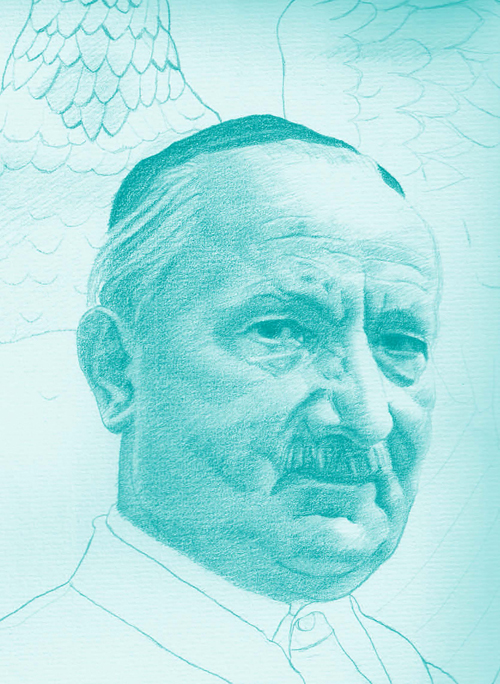
Portrait of Heidegger © Darren McAndrew 2013

Heidegger’s Philosophical Journey

Since the middle of the seventeenth century philosophy had been dominated by Descartes’ picture of a mind distinct from the body it inhabited. A first step away from this dualism was taken at the end of the nineteenth century by Husserl, who shifted philosophical focus from the entities of our experience to our experience of these entities. Husserl was a mathematician, and was interested in building logical structures dealing directly with the phenomena of experience. Heidegger went much further, decisively breaking free from the shackles of Cartesianism: he saw cognition and the use of language as firmly based on our innate capacities and on a bodily immersion in the world. Both men’s work was bold and highly original, representing a direct challenge to an approach to a philosophy which sought to emulate science. Heidegger had left religious studies for philosophy, and was a classicist who sought to return to the ancient, original concerns of philosophy, as he saw them. His approach has had much more appeal to literary-based academics than to scientifically-inclined ones. As a result, the chasm that had been opening up since Kant (1724-1804) between so-called ‘analytic philosophers’ (scientifically inclined and mostly Anglo-Saxon and English-speaking) and ‘continental philosophers’ (a convenient label for all the rest) has grown dramatically wider.
In his doctoral dissertation of 1914 Heidegger studied the relationship of logic to psychology. His habilitation thesis, necessary for him to be approved as a university teacher, examined the work of the medieval scholar Duns Scotus, and in his habilitation lecture he argued that the significance of time went far beyond the mere measurement of duration. (These were all strong indicators of what was to come, but Heidegger published nothing further until 1927.) In 1922 he was appointed to teach philosophy in the University of Marburg, about 80 kilometres from Frankfurt. There, away from his mentor Husserl, he found his own highly idiosyncratic voice, and laid the foundations for his masterpiece in nearly a decade of intensive reading, thinking and lecturing. Former students, including Hans Georg Gadamer and Hannah Arendt, recalled lectures of unparalleled brilliance. As he always lectured from carefully prepared written material, these students had the rare experience of seeing a work of genius emerging.
The masterwork Being and Time (Sein und Zeit) was published in 1927. It attracted instant attention. He already had a cult following among phenomenologists, but now he attained international fame. In 1928 he was invited back to Freiburg to succeed Husserl, who had retired. Heidegger became, and remained, the leading figure of the phenomenology movement.
Being and Time defies concise summary. It is one of the densest, most carefully thought out and distinctive contributions to philosophy ever made. It was never finished, and only the first parts were published. But it made, and continues to make, a huge impact, producing acolytes and denigrators in equal measure.
In Being and Time Heidegger was addressing the fundamental question: What is Being? What is it to be human – to be you or I; not a detached mind, but a feeling entity, immersed in and totally engaged with the world? He called such an entity Dasein. The word translates as ‘there-being’, but the translation is usually inverted to ‘being-there’. In colloquial German it means ‘existence’. The first English translators kept the German word, and ‘dasein’ is now a standard English term in phenomenology. (When first reading Heidegger it is helpful to mentally substitute for Dasein some familiar common term such as ‘humanity’ or ‘human being’, as appropriate.)
Heidegger’s world is very different from Descartes’ – it is the world of everyday experience; and in Being and Time he sought to slaughter the most sacred cow of philosophy, the preeminence of the intellect over everyday skills. He distinguished two distinct ways in which we relate to entities in the world, calling them ‘ready-to-hand’ (zuhanden) and ‘present-at-hand’ (vorhanden). Readiness-to-hand he illustrated by a famous example of a skilled craftsman using a hammer. The hammer is seen not as an isolated physical object, but as a ‘for-use-in-hammering’ – something ready to the craftsman’s hand which he wields skilfully but without conscious thought. Should the hammer break, the pieces are now regarded as present-at-hand: as a collection of new objects, not fit for any immediately recognisable purpose, and requiring conscious thought to decide how to effect any usefulness from them. These ideas were well ahead of their time, but are now commonplace both in philosophical criticisms of artificial intelligence and in applied psychology (see for example Daniel Kahneman’s Thinking, Fast and Slow, 2011).
Following Being and Time’s great success, Heidegger published little in the 1930s. His philosophical views shifted, placing less emphasis on the centrality of Dasein. Heideggerian scholars – a growing band – refer to this as die Kehre (the turn), and some have likened it to the change from early to late Wittgenstein. Heidegger himself always emphasised the continuity in his thought. He was highly organised, keeping a carefully maintained and meticulously organised record of all his lectures, notes, papers, books, seminars and correspondence. The collected works will eventually fill over 50 volumes. In later years much of his work was done at a cottage in the Black Forest where he lived a simple life, free from the predations of technology, and dressed in traditional Schwabian clothes.

Heidegger’s Dark Decade

The 1930s were a dark decade in Heidegger’s life, and those years still cast a persistent and deep shadow over his reputation. He deplored many aspects of the modern world, and writing in 1948 to former student Herbert Marcuse, said that he had “expected from National Socialism a spiritual renewal of life in its entirety, a reconciliation of social antagonisms and a deliverance of Dasein from the dangers of communism.” In 1933 he joined the National Socialist Party, to allow him to be put forward for the Rectorship of the University of Freiburg. However, refusing as Rector to support the removal of two anti-Nazi Deans, he resigned the Rectorship in 1934, but publicly supported the Nazi programme of educational reform. Then, having realised he had made a terrible choice, he tried to recover from the consequences. By the autumn of 1944 he had fallen so far from favour with the Nazi hierarchy that he was humiliatingly drafted into the Volkssturm (the ‘People’s Storm’, a sort of Nazi Home Guard) and was sent to dig anti-tank ditches along the Rhine. After the war, the DeNazification Committee banned him from teaching. The ban was lifted in 1951, and he was appointed to an emeritus professorship in Freiburg, in which he remained.
Many people behaved abominably in the Germany of the 1930s and 40s, including academics, and Heidegger’s behaviour by no means plumbed the depths to which some of his colleagues descended. But what most have found unforgivable was his complete silence after 1945 on Hitler, Nazism and the Holocaust. On condition that it was published only posthumously, he gave an interview on 23 September 1966 to Der Spiegel (it was published in June 1976), of which George Steiner has said “it is masterly in its feline urbanity and evasions.” Heidegger died in Freiburg on May 26th 1976, and was buried in Messkirch beside his parents in a graveyard he passed every day on his way to school. The gravestone is inscribed with a solitary star. This refers to a line he wrote in 1947: “To think is to confine yourself to a single thought that one day stands still like a star in the world’s sky.” But there are many stars in the philosophical firmament.
© Sir Alistair MacFarlane 2013
Sir Alistair MacFarlane is a former Vice-President of the Royal Society and a retired university Vice-Chancellor.

http://philosophynow.org/issues/94/Martin_Heidegger_1889-1976


Wednesday, December 19, 2012

1900

Amazing film review of Bertolucci's Epic 1900:


FINDING UTOPIA

Bertolucci's "1900"
By Cole Smithey

400px-Quarto_Stato  
"1900" (made in 1976) is Bernardo Bertolucci's crowning achievement of collectivist socio-political cinema. It is a grand scale, formally composed, Italian drama about a society of peasant farmers over a period of nearly 50 years, as seen through the eyes of two socially opposite boys. That the internationally-cast epic was made possible as a result of the vast success of Bertolucci's controversial "Last Tango In Paris" (1972) contributes to the mystique of "1900." The 35-year-old director's newfound status as a commercially viable and visionary filmmaker allowed his unhindered imagination, at the height of his powers, to complete his trilogy of fascist-themed films with an original script co-written with his brother Giuseppe and Franco Arcalli (both were co-screenwriters with Bertolucci on "Last Tango"). Where the first two films in the trilogy ("The Spider's Stratagem"--1970 and "The Conformist"-- 1971) live in a stylish bourgeoisie noir world of cloaked deceit, "1900" explores a vibrant familial identity existing between a group of socialist farmers, the landowners they work for, and fascist factions penetrating rural Parma, Italy. Its half-century scope provides a raw macro/micro slant on psychological, generational, political, and cultural changes in the region of Bertolucci's birth. Compared with the contained, at times claustrophobic, expressionist style of "Last Tango," "1900" is a 180-degree turn into a wide open direction.

1900poster6For his thirteenth film Bertolucci wanted to express what he saw as Italy's "multi-culture" society becoming a "mono-culture," due to the influence of the industrial revolution, and capitalism more precisely. The thick-layered chronicle doesn't sweep across time so much as it escorts the audience through indelible composite events that bristle with personal, social, and political characteristics. Luchino Visconti's influence, as well as that of Bertolucci's favorite director Jean Renoir ("The Rules of the Game"), arouse "1900's" particularly authentic sense of time, place, and attitudes of its decades. Bertolucci mentions following Renoir's advice to, "always leave a door open on the set, to allow reality to enter into the film." The result is a defiant naturalism and erotic candidness that colors the film with bursts of shocking emotional energy.

Present also is a connection to Bertolucci's mentor Pier Paolo Pasolini, and his film "Salo, or the 120 Days of Sodom," with which "1900" shares elements of style, form, and themes of fascist oppression. Bertolucci's first film job was working as an assistant to Pasolini on his first film "Accattone" (1961), and Bertolucci has pointed to Pasolini's death in 1975 as signaling the end of his utopian vision. Bertolucci's familiar cinematographer Vittorio Storaro ("Last Tango") captures an inspired color palate for a distinctly utopian vision in "1900" that goes from Van Gogh-inspired hues of golden hay to cold gothic grays that follow the story from spring through winter, from youth to old age.

Novocento PosterThe film's Italian title "Novecento" ("Twentieth Century") clarifies better than its American designation Bertolucci's bold intention of embracing the first half of Italy's 20th century through a utopic prism of poor Northern Italian socialist farmers living and working on the expansive country vineyard estate of their Padroné masters. We follow the trajectories of Olmo and Alfredo, born on the same day from opposite social classes. Three generations of historic Italian experience expose rural life in war-torn Italy. As "1900's" iconic deco-themed red and black poster implies, the story is a complex study of social decay under Mussolini's fascist ideologies. In spite of what some critics saw as a failed leftist screed, Bertolucci had no illusions regarding the potential for "1900," or any movie for that matter, to effect any degree of social change. For as passionate as Bertolucci's depiction of the peasant struggle is, he remains surprisingly ambiguous in representing matter-of-fact narrative threads that defy misinterpretation. For the sprawling amount of time the story covers, "1900" achieves an escalating, concussive dramatic punch through Bertolucci's magnificent use of montage to position polished scenes of a fictional history as translated from stories shared by local Parma farmers.

1900 De Niro"1900" is a movie that few audiences will ever properly see even if Robert De Niro, Gerard Depardieu, Bert Lancaster, and Donald Sutherland working together on a Bertolucci epic about fascist Italy might sound like a surefire recipe for box office success. Bertolucci's casting of Bert Lancaster as the Padroné Alfredo Sr. was as much a way of securing American production financing as it was a hat-tip to director Luchino Visconti who used Lancaster opposite Alain Delon and Claudia Cardinale for his great film "The Leopard" (1963), about a dying aristocracy in 1860's Sicily. In it, Lancaster plays the 19th-century aristocrat Prince of Salina, whose luxurious way of life is on its last gasp. Bert Lancaster also appeared in Visconti's "Gruppo di famiglia in un interno" which was released in the same year as "1900," although it was made in 1974.

Bert LancasterLancaster's performance as Alfredo Sr. in "1900" functions as a kind of Spaghetti Western abstraction, briefly giving the film a sense of Hollywood familiarity. A scene of Alfredo Sr. aiming rifles inside the main house at imaginary family members with his grandson, displays a lacking connection with his own son (played by Romolo Valli). The role of the secular Berlinghieri patriarch carries with it indelicate actions that would have been difficult for a less established actor to make as empathetic mark on the audience as Lancaster does in the role. In a white suit and matching hat Alfredo Sr. calls a pubescent peasant girl named Irma away from the outdoor afternoon festivities of her community to follow him into his estate barn. He grabs the nubile girl but is unable to get an erection. "Hey Senior Alfredo, nobody can milk a bull," Irma tells him after he asks her to put her hand inside his pants. Disgusted, he sends Irma away and tells her to report to the others when the dancing is over that he is dead. The Padrone's consequent suicide-by-hanging inside the barn indicates the end of an era that Bertolucci later completes with the self-satisfied death of the peasant leader Leo Dalco (Sterling Hayden) from old age while relaxing under a tree. In the competition of death, the peasant wins.

1900 bAt the time that Bertolucci contacted Gerard Depardieu to play the peasant socialist leader Olmo, the Gallic actor was already a major film star in Europe. Not one to pass up an opportunity to work in a challenging atmosphere, Depardieu brings to his characterization an earned sense of integrity that matches Lancaster's performance of dramatic weight. It is impossible to envision anyone other than Depardieu playing Olmo. The actor's muscular yet nuanced portrayal is on a scale with the best work of Marlon Brando or James Dean. He gives Olmo a beating heart of youthful consciousness that comes across effortlessly, even if it's another actor that dubs his voice. In the scene where Olmo returns home from war and sees his mother for the first time in ages, Depardieu generates volumes of silent subtext that's reflected in the eyes of Maria Monti as his mother. Bertolucci's use of the long conveyor belt of a noisy hay-bailing machine, where the mother and son come together, denies the family couple the peace they deserve, and puts a distinct price on their existence and ability to communicate.

1900Bertolucci was impressed with Robert De Niro's performance in Martin Scorsese's "Mean Streets," and hired the young actor over his other possible choice, Harvey Keitel. It was during this same period that De Niro would film "The Godfather II" and "Taxi Driver." As the upstart Padroné, Alfredo (Alfredo Sr.'s grandson), Robert De Niro peacefully coexists within the Italian setting of Parma but has the wrong voice for the part. His rhythms are too modern, and carry too much of New York's influence to convince us that he is the ineffectual Italian heir to vast riches. Nonetheless, De Niro's balancing act between Alfredo's masculine and feminine tendencies expresses Alfredo's unclear motivations and inner turmoil. De Niro's constant game of catch-up with his character works to imbue Alfredo with a sense of self-doubt and impotency that enables his unconventional charm to gradually pry apart at the character. The dubbing of Depardieu's voice works in a peculiar way to compensate for De Niro's inappropriate accent, and equalizes the unified characters in a sonic reality that could be construed as an intentional abstract touch by the filmmaker. That's not to say I wouldn't rather hear Depardieu's actual voice in the film but, all things considered, it works surprisingly well thanks in a large part to the talented yet unnamed voice-over actor that performed Olmo's voice.

NovecentoThe film's producers failed to appreciate the saga's ability to create a unique bond with an audience, and releasing the film became a matter for the courts. Problems arose primarily from conflicts between the film's production and distribution companies (Artemis Film, Artistes Associates, Produzioni Europee Associates, and Paramount Pictures) which each owned shares of the 5-hour-30-minute film's nearly $7 million-dollar production cost--a fortune at the time. A trial ensued over the film's duration, and an Italian judge was given three different versions to choose between. Apart from Bertolucci's long version, there was a 4-hour-40-minute edit in which many scenes were shortened but none eliminated, and a 3-hour-15-minute version that the studios edited themselves, and which Bertolucci considered to be "garbage." The presiding judge chose the 4-hour-40 minute rendering to represent the film's commercial product, and on November 4, 1977, "1900" was given a limited release in America.

Predictable box office failure coincided with neglect from the studios to advertise, market, or distribute the film properly. "1900" was christened an "outsider art film" destined to be lionized as a masterpiece of grand "folly" (Pauline Kael's word for it). When "1900" premiered at Cannes in 1976, its duration made critics like Roger Ebert believe it signaled the communist filmmaker's lack of control over a movie encompassing too much breadth of Italian experience. Since then, "1900" has come to stand as an organic cinematic journey through chapters of a rich apocryphal history that evinces an ongoing struggle between the world's rich elite and everyone else.

Il Quarto StatoGiuseppe Pellizza da Volpedo's famous oil painting "Il Quarto Stato," ("The Fourth Estate" - 1901), representing Italy's progressive movement, announces "1900's" ripe climate of social struggle as a background for the opening credit sequence. A lush Ennio Morricone horn motif plays as the camera pulls back slowly from the squinting eyes of a bearded peasant who breaks the painting's fourth wall, staring directly at the viewer while surrounded by his drably dressed kith and kin. A sad-eyed woman, most likely the man's wife, walks behind the headstrong leader of the socialist group, holding a baby boy, with her free hand outstretched in a pleading gesture. Her troubled physicality is reflected in the many tens of oppressed farm workers that follow their self-assured leader marching them toward inevitable conflict. The painting foreshadows Bertolucci's brilliant eye for creating vast painterly compositions of communal action whose scale, tone, and palate reflect Italian art of the period. Ezio Frigerio's exemplary art direction and Gitt Magrini's precise costume designs aid in fleshing out cinematographer Vittorio Storaro's serene framing that envelopes everything in the camera's scope. Storaro's artistic compositions and inspired use of natural light speaks to a deep understanding of the visual material at hand. Storaro would go on to shoot Warren Beatty's more commercially constructed epic "Reds" in 1981.

1900"The War is over." These objectively promising words from Liberation Day, April 25, 1945, are the first ones spoken in the film. A socialist peasant soldier crosses into the woods from a grassy field where a heard of cattle mill about on an otherwise peaceful and sunny day. A presumably Nazi soldier shoots a machine gun across the young man's belly; the boy stumbles back into the pasture carrying his guts in his bloody hands as the bell-rattling cows disperse. War is not over.

Fires burn in the distance and a peasant farmer on a bicycle passes rifles out to other farmers. A skinny young boy chases the man, begging for a rifle. "I want to kill too," he shouts after the man hands him a gun. The emboldened youngster goes into the home of the farm's white-haired Padroné, a complacent Alfredo Berlinghieri (Robert De Niro), and takes the elderly landowner prisoner to stand trial in the estate's open courtyard by peasants whose numbers have dwindled due to two World Wars, and an oppressive government that has imprisoned many of their number over the years. Bertolucci took inspiration for the impromptu tribunal that arrives in the film's final act from photos of the Chinese revolution. The red flags of revolt that Bertolucci uses as an image system of socialist solidarity and revolution are a repeated motif throughout several of his films, such as "Before the Revolution" and "The Last Emperor."
1900
Peasant women carry pitchforks and chase an elderly man dressed in a suit escaping with his frumpy wife on bicycles loaded down with heavy suitcases. The besieged man turns back to shoot at the approaching women with a small caliber pistol; they catch up with him and impale his arm and leg with pitchforks that they leave stuck in him so that he swings the long handles wildly while stumbling down a steep hill toward an angry peasant woman waiting with weapon in hand. Our initial reaction is to take pity with the elderly couple being attacked by a gang of blood-thirsty farm workers. Bertolucci crafted the sequence to engage the audience with a sadistic situation whose context will obtain a different response the second time it comes around in the framework of the story.

Broken into four periods to reflect the passing seasons, and split into two acts by an intermission, the story picks up in 1901, forty-four years before Liberation Day. A drunken hunchbacked jester (ala Verdi's "Rigoletto") breaks the silence of dawn with a tearful announcement of composer Giuseppe Verdi's death. Rigoletto's archetypal voice of exposition establishes an operatic theatricality that bookends the picture. Symphonic music swells over night's lingering blue light in 1901 when the peasant bastard Olmo Dalco, and Alfredo Berlinghieri, the landowner's heir, are both born. Olmo slips from the womb before Alfredo, causing sincere consternation in Bert Lancaster's uber Padroné, Alfredo Berlinghieri Sr. who complains vociferously.

Olmo-with-frogsBertolucci suspends the boys' parallel childhood friendship in a capsule of familiarity when each are burgeoning on puberty. Against Storaro's wide-lens landscape, Olmo is a vision of an Italian Huck Finn, full of vigor with a brown floppy felt hat adorned with twenty squirming frogs on a piece of wire. These are the same frogs that Olmo uses to chase off a girl who insults him, and that Alfredo will later spit out that night at his family's perfectly set dinner table.

Olmo plays a game of oneupsmanship with Alfredo by lying down between railroad tracks to let an oncoming train pass over him. The dangerous act becomes a leitmotif regarding Olmo's emotional and physical connection to the sun-kissed Italian terrain, as emulated by Alfredo when Olmo digs a hole in the ground to "screw the Earth." It also establishes the intimate nature of Olmo's and Alfredo's friendship, which will reoccur when the men share a epileptic prostitute after returning from serving in WWI.

"Ding Dong, Ding Dong. The Devil cares, the Padrone's scared." Olmo replies to Alfredo's question about whether he's dead or alive after letting the speeding locomotive roll over him. Unable to overcome his fear of the oncoming train, Alfredo has escaped from Olmo's side before the train arrived. Olmo's authentic children's rhyme carries an impression of childhood voodoo that Olmo uses as a prelude to spitting in Alfredo's face. Nothing is sacred in Olmo's world.

Paradoxically, a girl cries inconsolably because the seminary wants to take Olmo away to the priesthood. Olmo's grandfather Leo Dalco (Sterling Hayden) publicly strikes down the idea and silences a heckler who calls Olmo a "bastard" at the peasants' nightly communal sunset dinner. Hayden's imposing patriarch quells the verbal abuse and seizes the moment to ceremoniously indoctrinate Olmo into manhood with a directive speech that fulfills Bertolucci's thick narrative tapestry of theme, character, and plot lines.

"Now that you are grown, remember this: you will learn to read, you will learn to write, but you will still remain a son of peasants. You will go off to the army, you will see the world. You may even learn to obey (with kicks in the ass from morning till night), you'll take a wife, you will work for the lives of your children. But you will always remain a peasant."

Sterling HaydenLeo Dalco represents the old guard of the socialist farmers' relationship to their employers when he later preaches against "striking." Dalco warns his fellow farmers that their "league" (union) won't prepare them for the grass they will have to eat when they are not working. It's a tune that he soon changes when he's relaxing in the summer shade watching the Padroné and his wealthy friends and family working in the fields because the workers are on strike. Dalco passes away peacefully on a sunny hillside under the shade of tree knowing that his life has reached a new and different day. Even in death, the peasant Leo Dalco wins out against the Padroné, Alfredo Sr. (Bert Lancaster), and with more dignity.

When a storm wipes out the farm's crops, Alfredo Sr.'s son Giovanni (Romolo Vali), the estate's acting Padroné, calls the workers together to tell them that they must sacrifice half their pay to help compensate for his loss. The peasants reply that,Farmer"When we harvest double we don't get double pay." The insolent Padroné makes a pointed verbal attack at the day-laborers and goes too far when insults a farm worker about the large size of the man's ears. Without hesitation, the peasant takes out a sickle-shaped knife, raises it to his left ear and slices it off in one swift motion before putting his severed ear into Giovanni's hand. It's a gut-wrenching moment that clarifies the desperation of the workers and their level of outrage with their Padroné. The seed of revolution is sewn. We follow the wounded worker back to his family's hovel where he quietly delivers a few pieces of bread that his mother, father, wife, and children will rub against the dried carcass of fish that hangs over their old dinner table with flies swarming around it. He quietly refers to the incident as an accident, and carries on with his life, singing to his children to make them forget their hunger. The self-destructive act shows a wretched attempt to hold onto a deeply rooted human dignity that will overshadow his enormous sacrifice. There is no urge or time for self-pity.

Olmo and AlfredoTo Alfredo, Olmo describes himself a "socialist with holes in his pockets," and Alfredo later carries the enigmatic phrase with him after he returns from war, because it's how he wants Olmo to think of him. Alfredo could never in a million years be a socialist, even if he does refuse to contribute to a group of "New Fascists" at a church meeting he's persuaded to attend. The compliance of the church in fomenting fascism registers as part of the patriarchy that the community observes.
SutherlandDonald Sutherland embodies the estate's arrogant and ambitious foreman Attila Mellanchini who is abetted by Alfredo's contemptible cousin Regina (Laura Betti) to put himself forward as a self-fulfilled fascist leader afraid of "Mongol subversives who will kill and take over everything." Before making a gory public example of a cat that he equates as a communist, Attila tells his fascist comrades, "Communism is a disease that can destroy the world." Bertolucci makes a deliberate corollary between capitalism and fascism that helps explain the relationship of the peasants to the land they serve.

From a scene of the two boys watching a pro-revolution puppet show disbanded by stick-wielding police, to a red-flag adorned train platform where Olmo and Alfredo depart for war, Bertolucci establishes the shift of Olmo and Alfredo into grown men returning home from World War I, once again by train. 

Still wearing his army uniform, from the window Olmo witnesses his old friend Toro being hauled off by military police for striking.

Toro sees Olmo and yells, "Olmo, Olmo, The bastards got you. The country's in the hands of murderers! Goddamn the whole nation! Goddamn the King!"

It's a very short scene that contrasts the speed of modern transportation (Olmo's train), as a secondary form of cinematic movement, to emphasize the reality playing out in Olmo's beloved pastoral home that he is powerless to affect. The motif of peasants being inexplicably arrested repeats itself when Olmo's sense of purpose is stronger, and yet he is still just as unable to interfere.

The film's intermission comes with Attila (Sutherland) and his Black Shirts staring out into a vast public square where a battalion of soldiers on horseback have replaced red flag protesters, led by Olmo and his wife, yelling for the city to "Wake up!" while pulling the charred bodies of their families and friends burned to death by Mussolini's cold blooded military. Olmo's and Anita's desperate pleas fall on the deaf ears of their frightened neighbors.

Alfredo and AdaAct II marks a dark turn that finds the once bright Berlinghieri estate putrefying into a gothic and macabre atmosphere of fear and poverty. Alfredo ends having sexual trysts with his cousin, Attila's conniving wife Regina (Laura Betti), in favor of pursuing romantic love with a manic-depressive socialite beauty named Ada (exquisitely played by Dominique Sanda). The couple's budding romance is kindled by Alfredo's wealthy uncle Ottavio Berlinghieri (Werner Bruhns) who indulges the couple in a glowing golden afternoon of luxury and cocaine. At their wedding, Ottavio gives Ada a white horse for her wedding present. The horse carries a sub-textual meaning of control and mastery, and also serves to convey an omen of darkness in Ada's soon-to-be traumatized psyche. Bertolucci also uses the equine symbol to embody a fleeting example of agrarian culture that is symbolically trapped in Olmo's hunting net ("a trap for brides") in which Olmo captures Ada as she takes her wedding present for a ride moments before a terrible act of violence puts a blood stain on the post-wedding festivities.

1900_4Out of jealousy Regina insults Ada at the reception, but the gracious bride merely replies by taking off her veil and placing it on Regina's head in front of the crowd of on-looking party-goers.Regina rushes off in a fit of rage that culminates in taking Attila with her into the property's wine cellar where she demands that Attila make love to her. The dismal Gothic episode reveals the danger and anarchy of the fascist mindset. A boy named Patrizio, the son of one of Attila's Black Shirt accomplices, stumbles in on Regina and Attila in the midst of their coupling, and the pair seizes him to become the subject of their dubious affection. After Attila has sodomized Patrizio, he lifts up the child by his legs and swings him around in circles until the boy's head explodes against the beams of the circular cellar.

AttilaTo find the missing boy, the wedding guests conduct a search of the estate grounds that lead them to Patricio's bloody corpse inside the musty wine cellar. Thinking on his feet, Attila publicly accuses Olmo of committing the murder, and his Black Shirt bandits encircle the peasant leader before ruthlessly beating Olmo to a pulp while Alfredo looks on without attempting to protect his friend. Alfredo's betrayal of Olmo comes as a profound signifier of a change in his character. Alfredo, now married, chooses to fill the Padrone's shoes just like his father. The crowd shouts for Olmo's death, and it's only when a mentally indigent drifter steps forward to take credit for the brutal murder of the child that Alfredo finally steps in to defend Olmo. Alfredo announces the end of the reception amid the damp wooded area around the cellar. Ottavio complains to Alfredo about allowing Olmo to be beaten and observes that Alfredo "is becoming like them" [the fascists]. As Ottavio leaves, Ada begs him to stay; to which he replies that he will never set foot on the estate again. Ottavio's homosexual character serves as a thematic symbol of liberty and independent thinking. His self-exerted exile from the story comes as a bellwether of cultural collapses yet to come.

1900 cAlthough it encompasses the snaking reach of two World Wars, "1900" is not a war film. Bertolucci has said that he made "1900" as "a kind of dialogue" with his former mentor Pier Paolo Pasolini. By limiting the physical reach of the story, Bertolucci approaches his characters through a regional awareness of their communal significance as it diminishes against the developing industrial society around them. It is a story made from bits and pieces of anecdotal experience of people living in Parma over a long period. Bertolucci created a cinematic style to contain and fill decades of experience telescoped through the images captured by Vittorio Storaro's observant camera. The filmmaker used local farmers as extras in the film, and their presence adds another layer of historic knowledge to the authentically tempered narrative. Just as Orson Welles created a new scale of film with "Citizen Kane," so to has Bertolucci defined what the epic cinematic form is capable of containing.

Pes_636282"1900" took a heavy toll on Bertolucci. Making the film was a Herculean effort that went largely unrewarded, even if it did turn a respectable profit in Europe where it made 18 million dollars. Bertolucci's passion for showing the struggles of the people that he grew up around resulted in an inevitably bittersweet dialogue between two sides of the same coin--Padroné and peasant-- Alfredo and Olmo. Bertolucci's films are famous for splitting audiences. For every person who thinks "Last Tango In Paris" is a masterpiece, there is another who thinks it irredeemable. Bertolucci's social analysis in "1900" festers inside the bodies of its characters. The devastating destruction that Attila reaps on his neighbors is nothing short of a one-man war against humanity that works insidiously, under the guise of a political abomination, to gut a community already treading a delicate truce with poverty.

For the film's coda, Bertolucci alleviates the ongoing struggle between Olmo and Alfredo (peasant and Padroné) with a stroke of envisioned magical realism that allows the aged friends to bully each other as representatives of their social classes. Their relationship is at once fierce and forgiving. The two old men fight near the railroad tracks where they once shared their childhood together. Their collective memories give them a public common ground to communicate in a primitive way that releases their anger and mistaken ideas. But whether or not Olmo or Alfredo ever wakes up with an epiphany about resolving the nature of their disagreements matters not, because they continue to live in a collective spirit that represents the opposite of greed, without being patronizing to the other.
19001"1900" is a deeply personal vision of Italian history that demonstrates the heart of a social struggle that has come to be waged between corporations and its weary consumers. The ongoing dance between Olmo and Alfredo (representing Italy's political Left and Right), becomes a neutralizing paux de deux under Bertolucci's good humored gaze. If oblivion is its final result, then at least it can have a sense of shared experience. In this sense, Italy's history becomes the province of all countries through Bertolucci's daring efforts with a film that was pushed into an exile that only the most adventurous audiences can draw forth for its cathartic effect. As the extremes of class conflict become greater in the 21st century, "1900" is a tangible narrative synthesis that gets at the shadowy motivations and acts that perpetuate the inhospitable system plaguing our generations. When the farmers share their Padrone's estate with a group of arriving peasant refugees, we see the humanity of the communist ethos in action and realize the humanitarian values at stake. For a fleeting moment Bertolucci finds utopia, and so do we.