Wednesday, March 14, 2012

Jupiter and Venus

Tolga Bermek
Venus and Jupiter shine above the city of Mostar in Bosnia-Herzegovina on Monday in this photo snapped by skywatcher Tolga Bermek.
By

After creeping toward each other steadily for the last few months, Venus and Jupiter finally came together in what astronomers call a planetary conjunction Tuesday, putting on a spectacular show for skywatchers around the world.
The two planets lit up the night sky in tandem, appearing so close together that observers could blot them both out with just a few fingers held at arm's length. And they provided a lasting display, blazing bright above the western horizon for hours at mid-northern latitudes.
The celestial action Tuesday peaked when Jupiter and Venus lined up just 3 degrees apart in the night sky. (Your clenched fist held at arm's length measures about 10 degrees).
The show is not over, however. While the two bright planets have now begun moving away from each other in the sky, they'll remain quite close together for the next several days. [ Great Skywatcher Photos of Venus and Jupiter ]
Shawn Malone
Skywatcher Shawn Malone captured this view of Venus and Jupiter from near Eagle Harbor, Mich. In the image, the bright planets are setting over Lake Superior.
Wednesday night, for example, they'll be separated by just 3.1 degrees. By Thursday, the gap between them will have extended to about 3.5 degrees. Somewhat confusingly, Jupiter and Venus also technically come into conjunction on Thursday, when they line up in another set of celestial coordinates (though they will appear farther apart then to observers on the ground than they did Tuesday).
Venus-Jupiter conjunctions are fairly special events, occurring roughly every 13 months. This year's was especially stunning, experts say, because the two planets were visible for so long in the sky and appeared so bright.
Though Jupiter is about 11 times wider than the roughly Earth-size Venus, Venus appears about eight times more luminous these days. That's because Venus is so much closer to us than Jupiter is. On average, Earth orbits 93 million miles (150 million kilometers) from the sun, a distance defined as 1 astronomical unit (AU). Venus zips around our star at about 0.72 AU, while Jupiter is found roughly 5.2 AU from the sun.
So while the two planets appear close together in the night sky, in reality they're nowhere near each other. The orbits of Venus and Jupiter are separated by Earth, Mars and the main asteroid belt.
Though Venus has now wrapped up its celestial dance with Jupiter, it will provide another skywatching treat in just a few months. On June 5, Venus will cross the face of the sun from Earth's perspective, appearing as a tiny black dot against the face of our star.
Such Venus transits occur fewer than two times per century, on average. After June 5, the next one will take place in 2117.

http://www.msnbc.msn.com/id/46734632/ns/technology_and_science-space/#.T2FCs_W8GSq


Monday, February 06, 2012

What the Fuck is Love?

File:Hyacinthus.jpg
Hyacinth and Apollo from Wikipedia
Jacopo Caraglio (16th century), Apollo and Hyakinthus (after 1527). Engraving.


Love is a smoke made with the fumes of sighs;
Being purged, a fire sparkling in lovers' eyes;
Being vexed, a sea nourished with lovers' tears;
What is it else? A madness most discreet,
A choking gall, and a preserving sweet.


--Shakespeare, Romeo and Juliet

Love consists in this, that two solitudes protect and touch and greet each other.
Rainer Maria Rilke  

Because the word "love" is trite, abused, misused, sullied, and virtually meaningless in popular culture, it is the responsibility of philosophy and psychology to deconstruct love and to redefine it. Reading literature is essential in the endeavor.  To deconstruct it, we have to say what love most certainly isn't. It is not a Hollywood happy ending. It is not a fantasy in which the white knight rescues the distressed damsel. If history, philosophy, and psychology tell us anything, it is that a perfect relationship in which two people provide for each other's every need, who bring each other perpetual happiness, and satisfy the needs for sexual satisfaction, intellectual stimulation, shared interests, and pure devotion, is non-existent, whatever our doting grandparents may tell us to the contrary. Nor is love, as too often pictured in novels and in our parents' accounts, finding our soul mate who balances us perfectly and becomes our ideal mate for giving our parents grandchildren.

Continuing to deconstruct, we have to steer away from the opposite expressions of literature, film, and skeptical or cynical philosophy that equate love with negative traits, with selfish possessiveness, jealousy, domination, or mere lust and the will to power. As Leonard Cohen put it, "Love is not a victory march." Negative aspects of the human psyche arise when there is a failure to love.

The Greeks broke love down into two types, Eros and Agape which are not necessarily mutually inclusive or exclusive. Eros focuses on the passionate, sexual side of love, and includes a bit of craziness, the intoxicated, even mad side of love. Agape includes the mental, rational, intellectual, shared interests side. Possibly the most noble account of Agape, with or without Eros, is Aristotle's Book Eight of the Ethics (click). Since for Aristotle the unique quality of being human is our ability to reason, Love must be based on sharing our reasoning with a kindred spirit. The most essential elements of love are thus seeing the good in the other, wanting the other's well being as key to one's own, trust, empathy, time spent together sharing ideas, and companionship. Because Aristotle believed that one must be fundamentally good in order to be a good friend, respect for the other person's integrity becomes a key element in love.

Aquinas, building on Aristotle's ideas, found that love consists of wanting the other's well being and happiness, of finding happiness in the other's joys, and a sense of unity with the other. In modern times, the existentialists and the psychoanalysts called such unity inter-subjectivity.  In love the individual ego transcends itself, overcomes loneliness and alienation, to find connection, compassion, and intimacy with another. The wisest of these, Simone De Beauvoir, Otto Gross, Sartre, for example, rejected the false notion that one such connectedness should ever be exclusive. We find wholeness not by marriage to one other, but by a wealth, by an abundance of related connections with kindred spirits. 

As Shakespeare also wrote, Love does not alter when it alteration finds. Love is not time's fool. Erich Fromm*, and many other philosophers and psychologists have emphasized that if love is to have any meaning, it must include duration. Commitment, trust, care, acceptance of the evolution and growth of the person, are essential to love. Once we reach and cross the threshold of respect, admiration, shared values, honor of the other's personality, and desire for the other's well being and happiness, we begin to grow with, we share our becoming and are willing to experiment, to have adventures together. We embrace the Bohemian and the Beat in each other. We learn to laugh at ourselves, learn when to be serious and when to let go.This is not by any means a monogamous endeavor. Love should strive to be transitive-- life is best when those we love love each other as well. It is a difficult goal sometimes, but one that offers great rewards, as anyone who has experienced the beauty and uniqueness of a Menage-A-Trois can attest.
* Fromm considered love to be an interpersonal creative capacity rather than an emotion, and he distinguished this creative capacity from what he considered to be various forms of narcissistic neuroses and sado-masochistic tendencies that are commonly held out as proof of "true love." Indeed, Fromm viewed the experience of "falling in love" as evidence of one's failure to understand the true nature of love, which he believed always had the common elements of care, responsibility, respect, and knowledge. (Wikipedia)


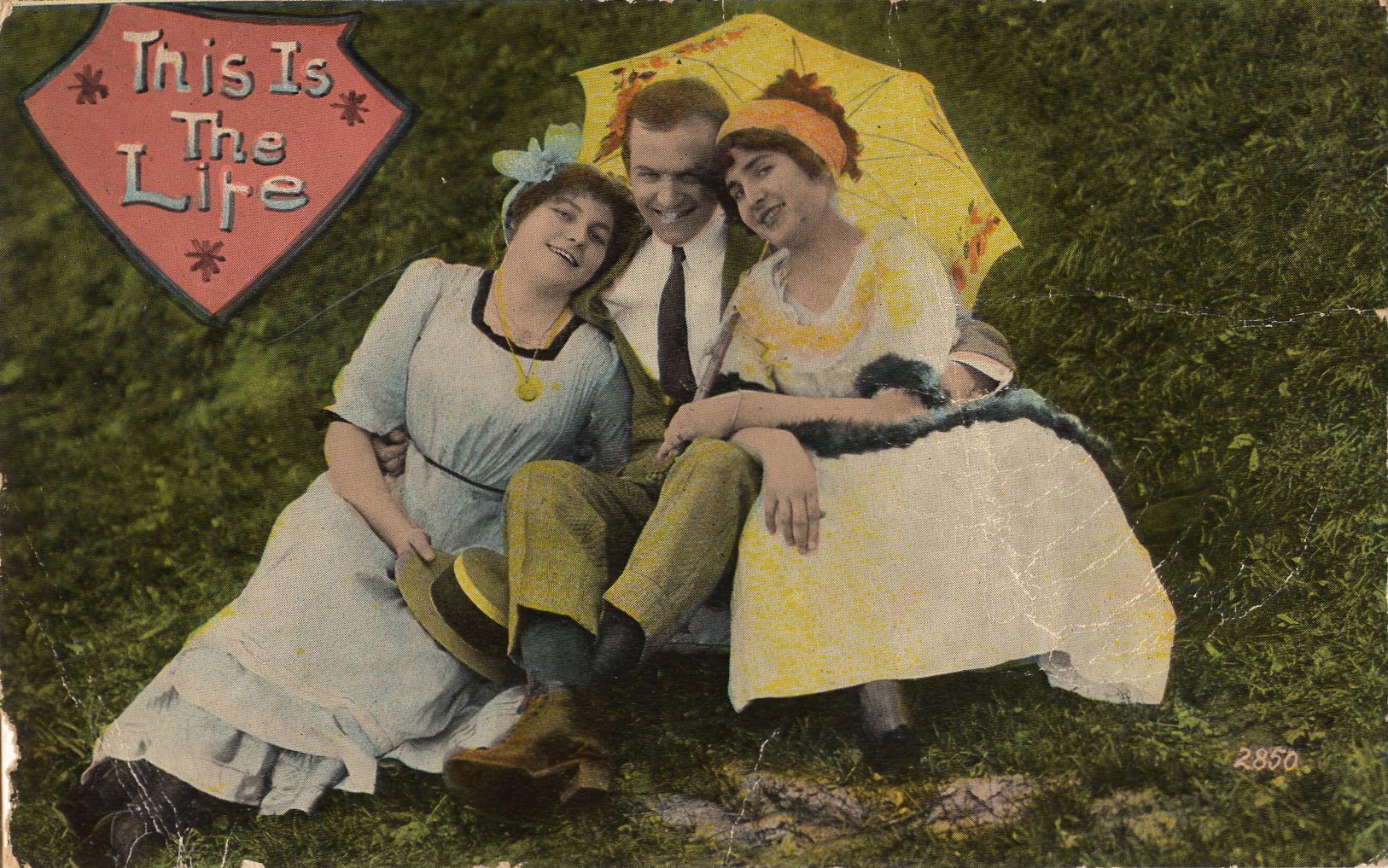
File:CardThisIsTheLife.jpg
Postcard, c. 1910
From  

Monday, January 30, 2012

3 Post-Impressionists: Reality as Intense Perception

L'Estaque 2 - Paul Cezanne - www.paul-cezanne.org
Cezanne

The Nineteenth Century ended in bright, astonishing color and eccentricity. Creative genius brought an end to the stifling dullness of Victorian repression. We witness the arrest of Oscar Wilde who wrote about the creation of London Fog by the Impressionists, claiming that nature imitates art. The transition to the 20th C. was filled with anguish and rebirth. Freud, Jung, Gross, and Spielrein spread open the secret recesses of the mind. Einstein presented an understanding of the universe that wiped out the old Newtonian order as surely as Pissarro and Cezanne brought an end to Impressionism, offering instead a new solidarity, a new vision of an even more colorful reality. Nothing would ever be the same. Mass became energy and energy mass. The Collective Unconscious lay open as archetypes emerged to replace the worn and dark images of the past.
Three artists stand out IMHO as heralding the revolution in artistic creation: Van Gogh, Cezanne, and Gauguin. 

Van Gogh

File:Vincent van Gogh - National Gallery of Art.JPG


"I can very well do without God both in my life and in my painting, but I cannot, suffering as I am, do without something which is greater than I am, which is my life, the power to create. "
Vincent Van Gogh


"I dream of painting and then I paint my dream.
"
Vincent Van Gogh

"It is better to be high-spirited even though one makes more mistakes, than to be narrow-minded and all too prudent. " Vincent Van Gogh


Vincent Van Gogh gave us a vision of a world colored with passion and intensity. His swirling skies, stars, trees, fields, and brightly intense faces showed a new subjectivity, a world of violent perception, akin to the visions of Shamans, of those seers mad on Peyote or other psychedelic drugs. The mind was no longer a mere passive receiver of images of nature, it became an active shaper of reality. Van Gogh unleashed the power of the mind as creator.

Cezanne

Self-portrait with Beret - Paul Cezanne - www.paul-cezanne.org

"Painting from nature is not copying the object; it is realizing one's sensations. "
Paul Cezanne

Paul Cezanne, building on the vision of Camille Pissarro, sought to solidify the ephemeral world of the Impressionists. Volume, mass, geometry, and color that display Cezanne's sensations, his mind's encounters with nature, rather than the exact copying of nature, fill  his paintings after the 1870s. He retains the awareness of light and its effects on everything, only with a fuller grasp of the underlying substance of what he paints. Cezanne frees his perceptions of the pre-conceived ideas of previous painters, of schools that imposed formal rules of composition and perspective upon reality, and on the way in which it is revealed. It is as if he removes Kant's categories of understanding and encounters nature and reality directly. Ernest Hemingway learned from Cezanne that when an artist renders the countryside or the images of others, the artist must focus on his own perceptions and sensations rather than slavishly recording, like mechanical photographic reproduction, of what he sees.
As Rilke said of poetry and all the arts after his encounter with Cezanne's paintings, "One has to be able at every moment to place one's hand on the earth like the first human being."

Gauguin 

" Art is either plagiarism or revolution."
Paul Gauguin


File:Paul Gauguin 111.jpg
"Art requires philosophy, just as philosophy requires art. Otherwise, what would become of beauty? "
Paul Gauguin


"Civilization is what makes you sick.
"
Paul Gauguin


Paul Gauguin made his dream, his philosophy, and his rejection of polite, hypocritical society, into a new subjective, romantic vision he came to inhabit. Like D.H. Lawrence, he despised European "civilization," with its rules of behavior, its religious self-righteousness, its artificiality,  its repression of creativity, sexuality, and natural connection to the Earth.
Like Lawrence, he traveled the world, filled with Wanderlust, eager for a more tribal reality in which people were in touch with nature and with each other. On ever remoter islands in the South Pacific around Tahiti, Gauguin realized what he was after, both in his life, his love, and his art.

As Gauguin described himself, he was "too savage a man to live a civilized life, too civilized to be a happy savage."

Note: Wikipedia has excellent galleries and links to all three artists and a fine article on Post-Impressionism, generally.


Jack 1/30/12

Thursday, December 22, 2011

Savannah Solstice 2011


Savannah
Forsythe Fountain

Our stay in Savannah has been rejuvenating. Mornings of meditation on our terrace have given me new perspectives to inform days ahead as we return to Atlanta and move on to the mountains of Tennessee. The Solstice  is sacred to me, not because of the birth of Jesus, or Mithra (same day) or any other particular incarnation of godhead. It is sacred to me as a Pantheist, as the seasons shift like Yeats' Gyres, and the longest night passes. The shadows change. There is a noticeable alteration and we all sense the beginning of a New Year. I feel a sort of completion as the Solstice passes.

To be here in this warm, sunny climate, drinking tea in the courtyard, or sipping champagne on the porch, reading Murakami in the spacious living rooms, surrounded by paintings, and decorative arts, is to be transported to an Epicurean garden where the wars, famine, capitalist conquests, political posturing, and man's inhumanity all momentarily dissolve. I recall Lars von Trier's Melancholia, and wonder if the world will meet its doom in 2012, after all, as some say the Mayans predict. What should one do if the world is going to end? I can think of nothing better than a walk along the shore, breathing sea air, watching the waves roll in.

Of course the Winter solstice is a time for feasting and merriment as well, right? We have done that too. Day and night after day of seafood. Wine. Good company. It is a time to let go of the planet's woes and just "Let The Sunshine In," to quote a wonderful play I saw in New York some 40 odd years ago.


Jack


Saturday, December 10, 2011

Thoughts and Reviews-- the Film, Shame

My view is the film should have been named "Desperation," not "Shame," since the main character never seems to show or to feel shame about anything. There is much to ponder here, and to tell the truth, the film is profoundly disturbing. I suppose it could also be called "Alienation," since there has never been a man more alienated from other people. Here are some reviews and other comments from my Facebook page:

  • http://movies.nytimes.com/2011/12/02/movies/shame-directed-by-steve-mcqueen-review.html
    Yet another great review. Love the ref. to William's Sonnet #129 which I'll post below. Amazing.

    movies.nytimes.com
    In “Shame,” the new feature from the British artist turned filmmaker Steve McQueen, the protagonist is a handsome, youngish Manhattanite who is hooked on sex.

    William Shakespeare - Sonnet #129
    The expense of spirit in a waste of shame
    Is lust in action; and till action, lust
    Is perjured, murderous, bloody, full of blame, 
    Savage, extreme, rude, cruel, not to trust;
    Enjoy'd no sooner but despised straight;
    Past reason hunted; and no sooner had,
    Past reason hated, as a swallowed bait,
    On purpose laid to make the taker mad:
    Mad in pursuit, and in possession so;
    Had, having, and in quest to have, extreme;
    A bliss in proof, and proved, a very woe;
    Before, a joy proposed; behind, a dream.

    All this the world well knows; yet none knows well
    To shun the heaven that leads men to this hell.


    Another Excellent Review:

    "Recorded in explicit but never pornographic detail, this is some of the most joyless sex ever put on screen, a compulsion to climax in which emotional connection plays no part. It's the fixation of a tortured individual aghast at the self-destructiveness of his addiction but unable to change his actions or escape the shame they cause."
  • http://www.latimes.com/entertainment/news/la-et-shame-20111202,0,2750231.story

    www.latimes.com
    ‎"Shame" is a dispassionate treatment of a disturbing topic, and therein lies its power. Sexually graphic enough to earn its NC-17 rating yet made with a restraint that's both unflinching and unnerving, this is a psychologically claustrophobic film that strips its characters bare literally and figuratively

  • entertainment.time.com
    Magneto lets it all hang out. Michael Fassbender — the German-Irish Adonis of the art house, who also played the young Magneto in this summer's X-Men: First Class — is on full-frontal display in the grinding sex drama Shame.


Sunday, December 04, 2011

Rilke's Birthday

A poem from Rilke:

Love Song

How can I keep my soul in me, so that
it doesn't touch your soul? How can I raise
it high enough, past you, to other things?
I would like to shelter it, among remote
lost objects, in some dark and silent place
that doesn't resonate when your depths resound.
Yet everything that touches us, me and you,
takes us together like a violin's bow,
which draws one voice out of two separate strings.
Upon what instrument are we two spanned?
And what musician holds us in his hand?
Oh sweetest song.


Rainer Maria Rilke


Tuesday, November 29, 2011

Koan

File:Bodhidharma.and.Huike-Sesshu.Toyo.jpg


Bodhidharma and Huike


Years ago A Zen Monk gave me a Koan to meditate upon. The Koan was, "Who is Jack Miller?"
A Koan is a rung on the latter to enlightenment. I am still here on the first step. So far, I have reached preliminary answers. First, in my case, "Jack Miller" is nothing. The name does not name me. If I have a name, it is Jack Jameson. Elsewhere in this blog I have answered the question from Romeo and Juliet, "What's in a name?" By citing my academic accomplishments and giving an account of my history. Am I my history? Not if Simone De Beauvoir and her beau are right. 
I share thoughts with another Zen Master-to-be these days who has given me the same Koan: "Become the person you want to be." The phrasing of course is different, wiser actually, more to it. Again, preliminary answers come to mind-- writer, lover, poet, philosopher. 
Part of the answer may also be who I am not now. I am not a Zen Master, and I write about this in a poem:


I have not resolved if a Zen Master is the person I want to be; and I suspect that saying, "in the future," is what De Beauvoir calls "Bad faith or mauvaise foi." 

I want to be on the path for now. The person I am and want to be is alive, full of passion, growing in compassion, knocked over with feelings of emotional pain and pleasure-- melancholy and joy. The person I want to be is learning to want less to attain a higher awareness.

File:Huike thinking.jpg


According to the Denkoroku, when Huike and Bodhidharma were climbing up Few Houses Peak, Bodhidharma asked, “Where are we going?” Huike replied, “Please go right ahead---that’s it.” Bodhidharma retorted, “If you go right ahead, you cannot move a step.” Upon hearing these words, Huike was enlightened.


Monday, November 28, 2011

Weekend

Because the following review is so well written and accurate, I will forgo writing my own review. Instead, I want to add that I found the film to be a look into the heart of homosexual love. There is something unique and wonderful about two men loving one another that is not the same as heterosexual love. This film reveals what that is in a way that is authentic and moving. Both kinds of love have their own beauty and truth, but there is a fascinating difference we are often too ready to overlook or deny. Weekend gives us a more profound understanding.


Weekend – review

A lo-fi, tremendously convincing account of contemporary gay life
4 out of 5
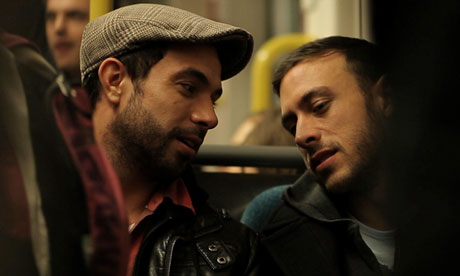
weekend film still
Something urgent to say about the windows of opportunity in our lives … Weekend
 
"Weekends, like life, are short." That melancholy reflection from Kind Hearts and Coronets does justice to some of Andrew Haigh's unassumingly excellent lo-fi feature: a boy-meets-boy love story extending over a single weekend, and filmed with a kind of real-time realism. There is sadness here, as well as romance, and a sense that sexual experience is not merely exciting for its own sake, but an adventure in defining one's sense of self: what one character here calls finding both partner and your self as a blank slate. Weekend has something urgent to say to both gay and straight audiences about the windows of opportunity in our lives.

Russell is a gay guy in his 20s who seems happy enough. We see him first at a party being thrown by his straight friends, with kids. He leaves early – to his hosts' disappointment – claiming to be tired, but on his way home on the bus he stops off at a gay bar, and meets Glen, who works at the local art gallery. They go home together for what both assume will be a fleeting, pleasurable fling. But in the morning, their conversation continues, and they wonder if they might have a future together. But first, they have to make some decisions on the subject of monogamy and what they want from life in the first place, and they discover they have far less time to make these decisions than they thought.
Russell is gentle, thoughtful, introverted; Glen is bold, worldly and a little confrontational in his need to assert his gay identity. In these roles, Tom Cullen and Chris New give tremendously relaxed and utterly convincing performances, very well directed by Haigh. It is the kind of film-making that looks easy, but isn't. For a lot of the time, nothing much is actually happening. Glen and Russell are hanging out, or drinking, or doing drugs, or having sex, and all these activities have an unselfconscious reality to them.
A more traditionally conceived "issue" movie would have included a scene of gay-bashing, but Haigh takes what looks like a conscious decision to defuse this particular dramatic firework. Glen yells at some gay-baiters from Russell's 14th-floor window, and on a railway platform, and he gets into a row with a straight guy in a pub, but there is no violence. Haigh's concern is always to refocus our attention on to a lower-key, but in its way far more sensational, subject: how Glen and Russell are going to work out their problems and find love. It is a tender, humane film, with an easy, unforced cinematic language: a film that doesn't need to try too hard.

 http://www.guardian.co.uk/film/2011/nov/03/weekend-film-review

Jack